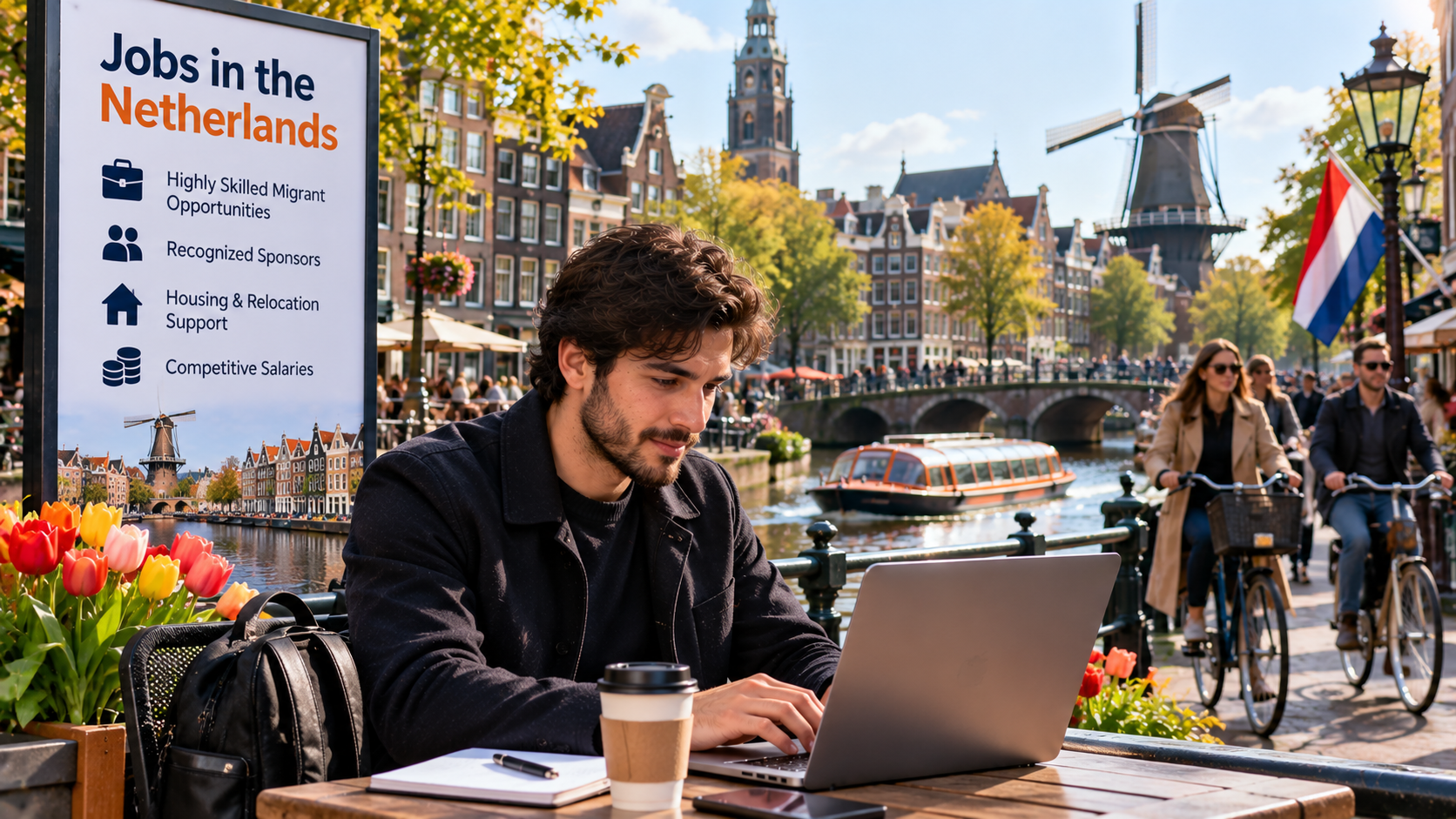
Netherlands Jobs for Highly Skilled Migrants: Salaries, Recognized Sponsors, Housing & Relocation Costs
The Netherlands is one of Europe’s strongest destinations for international professionals looking for high-skilled jobs in technology, engineering, semiconductors, finance, logistics, research, life sciences, renewable energy, consulting, and advanced manufacturing.
For non-EU workers, one of the most important immigration routes is the Dutch Highly Skilled Migrant permit, commonly known as the kennismigrant scheme.
This route is attractive because the immigration process is largely employer-led. However, not every Dutch company can use it. For a standard Highly Skilled Migrant application, your employer must generally be an IND-recognised sponsor, you must have an employment contract, your salary must meet the applicable income criterion, and the salary must also be market-conform for the position.
For 2026, the key monthly gross salary thresholds excluding holiday allowance are:
| Highly Skilled Migrant category | 2026 monthly salary requirement |
|---|---|
| Age 30 or older | €5,942 |
| Under age 30 | €4,357 |
| Reduced salary criterion | €3,122 |
| European Blue Card | €5,942 |
| Reduced European Blue Card criterion | €4,754 |
These thresholds apply throughout 2026.
For international workers, however, salary and immigration are only the beginning. A successful Dutch relocation also requires planning for temporary accommodation, permanent housing, banking, health insurance, international money transfers, Dutch credit history, mobile service, broadband, utilities, taxation, moving costs, and eventually long-term residence or home ownership.
How the Netherlands Highly Skilled Migrant Route Works
The Highly Skilled Migrant scheme is designed for qualified international professionals recruited by Dutch employers.
The main requirements generally include:
- An employment contract with a Dutch employer or research institution
- An employer recognised by the IND as a sponsor
- Salary meeting the applicable income requirement
- Compensation that is market-conform for the occupation
- Compliance with general Dutch residence requirements
The Dutch Immigration and Naturalisation Service, or IND, states that only an employer recognised by the IND can apply for a Highly Skilled Migrant residence permit under the standard scheme.
That is an important difference from ordinary job searching.
A Dutch company can advertise an excellent vacancy but still be unable to use the Highly Skilled Migrant procedure if it is not an appropriate recognised sponsor.
What Is an IND-Recognised Sponsor?
A recognised sponsor is a company or organisation formally recognised by the Dutch Immigration and Naturalisation Service.
The IND evaluates factors such as:
- Reliability
- Business continuity
- Financial health
- Chamber of Commerce registration
Recognised sponsors receive advantages including a faster immigration procedure and reduced documentation requirements. The IND aims to process many applications from recognised sponsors within approximately two weeks, although some cases can take longer.
The employer also has legal responsibilities relating to:
- Record keeping
- Providing information to the IND
- Duty of care
Recognition therefore represents more than simply being an employer willing to hire foreigners.
How to Check Recognised Sponsors
The IND maintains a public register for organisations recognised for work and Highly Skilled Migrant sponsorship.
The register is updated monthly.
The available register was last updated on 3 September 2026 and contains thousands of recognised organisations.
When applying for a job:
- Find the vacancy.
- Identify the employer’s legal company name.
- Search the IND Public Register Work.
- Confirm that the organisation appears.
- Ask the recruiter whether the specific vacancy qualifies for Highly Skilled Migrant sponsorship.
Do not assume that appearing on the register means every vacancy at the company will be sponsored.
The employer can still decide to sponsor only:
- Specialist roles
- Senior positions
- Hard-to-fill vacancies
- Jobs above certain salary levels
Highly Skilled Migrant Salary Thresholds in 2026
Salary is one of the most important eligibility tests.
Workers Aged 30 or Older
The 2026 monthly gross salary criterion is:
€5,942 per month
excluding holiday allowance.
Annualised over 12 months, that represents approximately:
€71,304 gross
before holiday allowance.
Workers Under Age 30
For qualifying Highly Skilled Migrants under age 30:
€4,357 per month
excluding holiday allowance.
That equates to approximately:
€52,284 annually
before holiday allowance.
Reduced Salary Criterion
A reduced salary threshold of:
€3,122 per month
can apply in specified circumstances, including certain qualifying graduates and former orientation-year permit holders.
This reduced criterion can make the Netherlands particularly attractive to international graduates transitioning into skilled employment.
Do not assume it applies simply because you recently graduated abroad.
The applicant must fit one of the recognised situations.
European Blue Card
The Netherlands also offers the European Blue Card.
The 2026 salary criterion is:
€5,942 per month
while the reduced Blue Card salary threshold is:
€4,754 per month.
One important difference is that recognition as an IND sponsor is not mandatory for every European Blue Card employer in the same way that it generally is for the national Highly Skilled Migrant scheme.
International professionals should therefore compare:
- Highly Skilled Migrant permit
- European Blue Card
- Intra-corporate transfer
- Other skilled residence routes
before deciding which route best fits their employment situation.
High-Potential Netherlands Jobs for International Workers
Software Engineering
The Dutch technology market recruits international professionals for positions including:
- Software Engineer
- Backend Developer
- Full-Stack Developer
- Cloud Engineer
- DevOps Engineer
- Platform Engineer
- Site Reliability Engineer
- Mobile Developer
- Solutions Architect
English-speaking engineering teams are particularly common in:
- Amsterdam
- Eindhoven
- Rotterdam
- Utrecht
- The Hague
Employers hiring Highly Skilled Migrants usually need compensation high enough to satisfy both the immigration salary threshold and normal market pay.
Senior engineers therefore often have stronger sponsorship prospects than junior developers.
AI, Data and Machine Learning
Demand also exists for professionals in:
- Artificial Intelligence
- Machine Learning
- Data Science
- Data Engineering
- MLOps
- Analytics
- Computer Vision
- Natural Language Processing
These jobs can be particularly valuable to employers in:
- Technology
- Finance
- Logistics
- Semiconductors
- Healthcare
- Research
Strong candidates should demonstrate more than certificates.
Employers often want evidence that you have built and deployed real production systems.
Semiconductor and High-Tech Engineering
The Eindhoven region is especially important for advanced technology and semiconductor employment.
International workers can target roles involving:
- Electrical Engineering
- Mechanical Engineering
- Mechatronics
- Embedded Systems
- Semiconductor Engineering
- Optics
- Robotics
- Manufacturing Engineering
The Netherlands has a significant ecosystem of multinational technology employers and suppliers that routinely hire specialists from abroad.
These jobs can be particularly suitable for Highly Skilled Migrant sponsorship because technical specialists often earn salaries above immigration thresholds.
Finance and Fintech
Amsterdam is a major European financial centre.
International candidates can find roles in:
- Risk
- Compliance
- Financial Analysis
- Quantitative Finance
- Payments
- Banking Technology
- Treasury
- Internal Audit
- Data
- Fintech
Multinational financial employers may offer:
- Immigration support
- Relocation allowances
- Temporary accommodation
- Tax assistance
Do not compare finance offers by base salary alone.
Check:
- Annual bonus
- Pension
- Holiday allowance
- Relocation
- Equity
- Tax benefits
Engineering
International professionals may also find opportunities in:
- Mechanical Engineering
- Electrical Engineering
- Civil Engineering
- Chemical Engineering
- Renewable Energy
- Offshore Engineering
- Process Engineering
- Industrial Automation
Rotterdam, Eindhoven and other industrial regions can offer opportunities outside the expensive Amsterdam employment market.
Life Sciences and Research
The Netherlands also has a significant:
- Pharmaceutical
- Biotechnology
- Medical technology
- University research
sector.
Potential jobs include:
- Research Scientist
- Bioinformatician
- Laboratory Specialist
- Clinical Research Professional
- Data Scientist
- Research Engineer
Research organisations can use separate recognised-sponsor structures where relevant.
The IND maintains a specific public register of recognised research sponsors in addition to its work register.
Major Recognised Employers to Research
The Netherlands’ sponsor register contains thousands of employers, so applicants should not limit themselves to a handful of famous names.
International candidates commonly research large employers in areas such as:
- Technology
- Semiconductors
- Finance
- Logistics
- Consulting
- Engineering
- Pharmaceuticals
Potential companies to investigate can include organisations such as:
- ASML
- Philips
- Booking.com
- ING
- ABN AMRO
- Rabobank
- Adyen
- Shell
- AkzoNobel
- DSM-Firmenich
- Deloitte
- PwC
- EY
- KPMG
- Major universities and research centres
Always verify the current legal entity in the IND sponsor register before assuming sponsorship is available.
Companies restructure, subsidiaries differ, and individual vacancies have their own policies.
Recruitment Agencies
International professionals can also use established Dutch recruitment firms.
Common recruitment channels include:
- Indeed Netherlands
- Glassdoor
- Employer career portals
- Specialist technology recruiters
- International recruitment agencies
For English-speaking international candidates, agencies specialising in expat recruitment can sometimes help identify employers accustomed to immigration procedures.
Never pay an unknown recruiter for a “guaranteed recognised sponsor job.”
A genuine recruiter may help you find an employer, but only the recognised employer and IND can complete the Highly Skilled Migrant immigration process.
Netherlands vs UK Sponsorship
The Netherlands and United Kingdom both rely strongly on approved employers for major skilled-worker routes, but the systems differ.
The Netherlands focuses heavily on:
- IND-recognised sponsorship
- Age-based salary thresholds
- Market-conform salary
while the UK Skilled Worker route uses:
- Licensed sponsors
- Occupation codes
- General salary thresholds
- Occupation-specific going rates
If you are comparing these two destinations, see this guide to UK visa sponsorship jobs for foreign workers for the UK employer and salary framework.
Salary Packages: What to Compare
Dutch employers may express compensation using:
- Gross monthly salary
- Gross annual salary
- Holiday allowance
- Annual bonus
- Performance bonus
- Equity
- Pension
- Mobility budget
- Relocation allowance
Before accepting an offer, establish whether the quoted salary:
- includes holiday allowance;
- excludes holiday allowance;
- includes a guaranteed bonus;
- qualifies for the immigration salary criterion.
IND thresholds for Highly Skilled Migrants are based on gross salary without holiday allowance.
That distinction is important.
An attractive total package does not necessarily mean the immigration salary component qualifies.
The Dutch Expat Scheme and 30% Facility
Certain employees recruited from abroad may qualify for the Dutch Expat Scheme, often referred to as the 30% facility.
For 2026, an employee generally needs qualifying salary above:
€48,013 per year
excluding the tax-free allowance to meet the expertise salary criterion.
For qualifying employees under age 30 with an eligible academic master’s degree or equivalent:
€36,497
is the relevant 2026 salary threshold.
The employer and employee must meet other conditions as well, including rules concerning recruitment from abroad and previous residence distance from the Dutch border.
The Dutch Tax Administration states that an employer may, where the conditions are satisfied, provide up to 30% of qualifying salary as a tax-free allowance for extraterritorial expenses.
Do not assume every Highly Skilled Migrant automatically receives the 30% facility.
It is a separate tax arrangement.
Ask the employer:
- Will you apply for the expat scheme?
- Does my compensation satisfy the 2026 criterion?
- Is the quoted net salary estimate dependent on approval?
- Who pays for tax advice?
Relocation Packages
Large recognised sponsors may provide relocation benefits such as:
- Immigration lawyer or relocation consultant
- IND application support
- Flight reimbursement
- Temporary accommodation
- House-search assistance
- Moving allowance
- International shipping
- Registration support
- Tax assistance
- 30% facility application help
- Family relocation
Some companies provide a fixed relocation payment.
Others arrange services directly.
Before accepting an offer, request a breakdown.
A €5,000 relocation allowance can have very different value depending on whether the company separately covers:
- Immigration
- Hotel
- Flights
- Shipping
Clear 2026 Application Roadmap
Step 1: Select Your Target Occupation
Choose jobs that genuinely match:
- Education
- Experience
- Technical expertise
- Seniority
Do not search only for “visa sponsorship jobs.”
Search your actual profession.
Step 2: Determine Your Salary Threshold
For 2026:
- Age 30+: €5,942/month
- Under 30: €4,357/month
- Reduced criterion: €3,122/month
Check which category actually applies to you.
Step 3: Identify Recognised Sponsors
Use the IND Public Register Work.
Build a list of companies in your:
- Industry
- City
- Profession
Step 4: Search Current Vacancies
Use:
- Employer career pages
- Indeed
- Specialist recruiters
Search both:
Highly Skilled Migrant
and your normal job title.
Step 5: Prepare a Netherlands-Focused CV
Highlight:
- Relevant experience
- Technical skills
- Education
- Certifications
- Languages
- Measurable achievements
Keep it concise.
Step 6: Apply Directly
Prioritise vacancies that:
- Match your experience
- Pay above the required threshold
- Come from recognised sponsors
Step 7: Confirm Sponsorship
Ask:
“Will this role be sponsored under the Dutch Highly Skilled Migrant scheme?”
Do not simply ask whether the company hires foreigners.
Step 8: Compare Total Compensation
Check:
- Gross salary
- Holiday allowance
- Bonus
- Pension
- Equity
- Relocation package
- 30% facility support
Step 9: Receive the Employment Contract
Ensure the contract accurately states:
- Employer
- Job title
- Salary
- Working hours
- Start date
Step 10: Employer Submits the IND Application
A recognised sponsor generally submits the application on your behalf.
The recognised-sponsor process can allow faster processing than ordinary residence procedures.
Step 11: Complete Entry Requirements
Depending on your nationality and circumstances, immigration procedures can also involve an MVV entry visa.
Follow the exact IND instructions for your case.
Step 12: Arrange Temporary Housing
Do not rush into a long Dutch lease remotely.
Book flexible accommodation for your first few weeks.
Step 13: Move to the Netherlands
Carry:
- Passport
- Employment contract
- Immigration decision
- Housing documentation
Step 14: Register Locally
Complete municipal registration where required and obtain the administrative records necessary for local life.
Step 15: Open a Dutch Bank Account
Set up:
- Salary payments
- Direct debits
- Debit card
- Savings
Step 16: Arrange Health Insurance
Workers living in the Netherlands may need Dutch health insurance depending on their circumstances.
Complete this promptly after relocation.
Step 17: Start Payroll
Keep:
- Payslips
- Employment agreement
- Tax documentation
Step 18: Find Permanent Housing
Once you understand the city, commute and net salary, compare rentals.
Step 19: Establish Your Financial Profile
Pay:
- Rent
- Utilities
- Insurance
- Telecom
on time.
Step 20: Plan Long-Term Residence
Review future options for:
- Permanent residence
- EU long-term residence
- Naturalisation where eligible
The practical sequence is:
profession → salary threshold → recognised sponsors → applications → interview → employment contract → IND application → relocation → registration → bank account → health insurance → permanent rental → long-term settlement
The Dutch Housing Challenge
Housing deserves serious attention before accepting a Netherlands job offer.
The country’s private rental market remains tight.
Pararius reported that in the second quarter of 2026, new tenants in the unregulated rental sector paid an average:
€1,882 per month
while average rent reached:
€20.94 per square metre.
More than four in ten available private-sector rentals were priced above €2,000 per month.
This can materially reduce the value of a high salary.
Amsterdam Rental Costs
Amsterdam remains the most expensive major Dutch rental market.
In Q2 2026, Pararius reported an average private-sector rent of:
€28.69 per square metre
for newly rented properties.
For a 60 m² property, that rate would represent roughly:
€1,721 per month
before considering differences in property type, furnishing, service charges and utilities.
Actual listings can be materially higher.
Rotterdam
Rotterdam averaged:
€22.79 per square metre
in Q2 2026.
A 60 m² property at that average would be approximately:
€1,367 per month.
The Hague
The Hague averaged:
€22.42 per square metre.
It can be attractive for professionals working in:
- Government-related organisations
- International institutions
- Legal services
- Technology
- Energy
Utrecht
Utrecht averaged:
€21.61 per square metre.
Its central location and strong employment market make it popular with commuters.
Eindhoven
Eindhoven averaged:
€20.25 per square metre.
For high-tech workers, this can provide an interesting salary-to-rent balance compared with Amsterdam.
Housing Income Requirements
Landlords in the Dutch private market may require gross income several times the monthly rent.
That means a worker earning enough for immigration can still face difficulties renting an expensive Amsterdam apartment.
For example, a €2,000 rental could require significant documented household income depending on landlord policy.
Keep:
- Employment contract
- Employer statement
- Payslips
- Bank statements
- Residence documents
available when applying.
Temporary Housing
Temporary accommodation options include:
- Serviced apartments
- Aparthotels
- Furnished apartments
- Corporate housing
- Extended-stay accommodation
International workers may know brands such as:
- Staycity
- SACO
- Cheval Collection
but availability varies by Dutch city, so check current local inventory rather than assuming coverage.
Temporary housing for several weeks can be expensive, but it may be safer than signing a long lease without seeing the property.
Furnished vs Upholstered Rentals
Dutch rental listings commonly distinguish between:
- Furnished
- Upholstered
- Shell or bare accommodation
Pararius reported that furnished properties carried the highest average price per square metre in Q2 2026.
A furnished apartment can make sense during the first year because it reduces:
- Furniture purchases
- Moving costs
- Setup time
But workers planning to remain several years may find an upholstered or unfurnished property more economical.
Property Platforms
Common Dutch rental-search platforms include:
- Pararius
- Funda
- HousingAnywhere
- Kamernet for selected room searches
- Local estate agents
International applicants should compare:
- Rent
- Service charges
- Utilities
- Deposit
- Furnishing
- Contract duration
Do not compare properties using headline rent alone.
Rental Scam Protection
Housing shortages create opportunities for scams.
Warning signs include:
- Rent far below market
- Landlord claiming to live permanently overseas
- Pressure to transfer money immediately
- Refusal to conduct a viewing
- Cryptocurrency payment
- Copied listing photos
Verify:
- Agent
- Property
- Contract
- Payment details
before transferring a deposit.
Banking in the Netherlands
Major Dutch banks include:
- ING
- ABN AMRO
- Rabobank
- bunq
International workers may also use services such as:
- Revolut
- Wise
Compare:
- Monthly account fee
- Debit card
- Mobile banking
- International transfers
- Savings
- ATM access
You may need local identity and registration information when opening certain products.
Credit Cards and Credit Registration
The Netherlands generally relies heavily on:
- Debit cards
- Bank transfers
- iDEAL
- Direct debit
rather than U.S.-style credit-card borrowing.
Credit products can still affect your financial profile.
Avoid unnecessary borrowing simply to “build credit.”
For most new migrants, establishing:
- Stable employment
- Reliable payments
- Savings
- Clean financial records
is more important.
Personal Loans and Existing Debt
If considering a Dutch personal loan, compare:
- Interest
- Monthly payment
- Term
- Total borrowing cost
A new migrant can have more limited lending options.
Continue including overseas:
- Credit cards
- Student loans
- Mortgages
when calculating affordability.
Health Insurance
Health insurance is a major relocation expense in the Netherlands.
Workers should check whether their situation requires Dutch basic health insurance and arrange appropriate coverage promptly.
Compare insurers based on:
- Monthly premium
- Deductible
- Provider network
- Additional cover
Do not treat employer immigration support as automatically including personal health insurance.
Contents and Liability Insurance
International renters may also consider:
- Contents insurance
- Personal liability insurance
These can provide protection against events such as:
- Theft
- Fire
- Water damage
- Liability claims
Compare coverage limits, deductibles and exclusions rather than choosing only the lowest premium.
International Money Transfers
Workers moving savings into euros can compare:
- Wise
- Revolut
- OFX
- Traditional banks
Review:
Exchange rate + FX margin + transfer fee + final EUR received
For large transfers, providers may ask for source-of-funds documentation.
Keep:
- Bank statements
- Employment contract
- Investment records
available.
Mobile Plans and eSIM
Major Dutch mobile providers include operators such as:
- KPN
- Vodafone
- Odido
Compare:
- Prepaid
- SIM-only
- Contract
- eSIM
- Data
- EU roaming
A prepaid or flexible plan can be useful immediately after arrival before your banking and registration are fully established.
Broadband
Major fixed-internet options can include:
- KPN
- Ziggo
- Odido
Compare:
- Fiber availability
- Cable
- Download speed
- Upload speed
- Router
- Installation
- Contract duration
Always check the exact property address before signing up.
Utilities
Depending on your tenancy, you may need to arrange:
- Electricity
- Gas
- Heating
- Water
- Internet
Ask the landlord whether service charges include any utilities.
Take meter readings when moving in where appropriate.
Taxes and Payroll
Employees normally receive salary through Dutch payroll.
Your payslip can include deductions relating to:
- Income tax
- Social contributions
- Pension where applicable
Net salary can therefore differ significantly from gross salary.
International workers should base housing affordability on expected net monthly income, not gross annual compensation alone.
Using the Expat Scheme in Financial Planning
Do not sign an expensive apartment based on an assumption that you will receive the maximum 30% tax-free allowance.
The Dutch Tax Administration makes clear that eligibility has separate conditions and the employer must participate in the application.
Budget initially using a conservative net-salary figure.
Treat any approved expat benefit as additional financial flexibility rather than money already guaranteed.
International Moving
Compare:
- Excess baggage
- Air freight
- Sea freight
- International movers
- Corporate relocation providers
Request several quotes.
Compare:
- Weight
- Volume
- Insurance
- Customs
- Delivery time
- Storage
If the employer provides a relocation budget, ask whether shipping expenses reduce the amount available for temporary accommodation.
Storage
Storage may be useful during the move from temporary to permanent housing.
Compare:
- Self-storage
- Moving-company storage
- Pickup-and-delivery services
Review:
- Monthly fee
- Insurance
- Access
- Minimum period
- Security
Complete Netherlands Relocation Cost Framework
A new Highly Skilled Migrant should budget across several stages.
Before Relocation
Potential costs:
- Document preparation
- Translation
- Flight
- Moving quote
- Initial accommodation
First Weeks
Budget for:
- Temporary housing
- Transport
- Food
- Mobile data
- Administrative costs
Moving Into a Rental
Possible expenses include:
- Deposit
- First rent
- Furniture
- Utilities
- Internet
- Insurance
Monthly Budget
Include:
- Rent
- Health insurance
- Utilities
- Transport
- Mobile
- Broadband
- Food
- Debt
- Savings
With the average unregulated-sector rental reaching €1,882 per month in Q2 2026, housing can be one of the largest costs even for well-paid Highly Skilled Migrants.
Preparing for Home Ownership
Highly Skilled Migrants who remain in the Netherlands long term may eventually consider buying property.
Mortgage lenders can assess:
- Income
- Employment contract
- Residence status
- Existing debt
- Savings
- Property value
Potential mortgage providers include major Dutch banks such as:
- ING
- ABN AMRO
- Rabobank
Mortgage suitability depends heavily on your individual financial and residence situation.
Do not assume that earning above the Highly Skilled Migrant threshold guarantees mortgage approval.
Frequently Asked Questions
What salary do I need as a Highly Skilled Migrant in the Netherlands in 2026?
The monthly gross threshold excluding holiday allowance is €5,942 for workers aged 30 or older and €4,357 for workers under 30. A reduced €3,122 criterion applies in specified circumstances.
Does my employer need to be a recognised sponsor?
For the standard Highly Skilled Migrant route, generally yes. The employer or research institution must be recognised by the IND.
Where can I check recognised sponsors?
Use the IND Public Register Work. It is updated monthly and lists organisations recognised for work and Highly Skilled Migrant sponsorship.
Does being on the sponsor register guarantee a job with sponsorship?
No. Recognition allows the employer to use the route, but the company decides which vacancies it will sponsor.
Is there an age-based salary difference?
Yes. Highly Skilled Migrants under 30 have a lower standard monthly salary criterion than workers aged 30 or older.
Can recent graduates use a lower salary threshold?
Certain qualifying graduates and former orientation-year candidates can use the reduced Highly Skilled Migrant salary criterion of €3,122 per month in 2026. Eligibility must be checked carefully.
What is the European Blue Card salary requirement?
The standard 2026 Blue Card criterion is €5,942 per month, with a reduced criterion of €4,754 where applicable.
How expensive is renting in the Netherlands?
The average rent for a newly leased property in the unregulated sector reached €1,882 per month in Q2 2026.
How expensive is Amsterdam?
Amsterdam’s average private-sector rent reached €28.69 per square metre in Q2 2026, making it the most expensive city in the Pararius data.
What is the 30% expat facility?
Qualifying employees recruited from abroad may be able to receive part of their salary as a tax-free allowance for extraterritorial costs. For 2026, the general expertise salary threshold is €48,013, subject to additional conditions.
Which Dutch banks should newcomers compare?
Common options include ING, ABN AMRO, Rabobank, bunq, plus international financial services such as Wise and Revolut where suitable.
Can a Highly Skilled Migrant eventually buy a home?
Potentially. Mortgage eligibility depends on salary, employment, residence status, debt, savings, property value and lender policy.
Final Thoughts
The Netherlands Highly Skilled Migrant route remains one of Europe’s clearest employer-led immigration options for qualified international professionals.
The key 2026 salary thresholds are:
- €5,942 per month for workers aged 30 or older
- €4,357 per month for workers under age 30
- €3,122 per month under the reduced Highly Skilled Migrant criterion
- €5,942 per month for the standard European Blue Card
- €4,754 per month under the reduced Blue Card criterion
All figures are gross monthly salary excluding holiday allowance.
The employer is equally important. Under the standard Highly Skilled Migrant route, the company must generally appear in the IND Public Register of Recognised Sponsors, and the agreed salary must also be appropriate for the actual job.
Housing should then form part of the employment decision. Average unregulated-sector rent reached €1,882 per month in Q2 2026, while Amsterdam averaged €28.69 per square metre. Rotterdam, The Hague, Utrecht and Eindhoven offered lower average price-per-square-metre levels, making location an important financial comparison.
The clearest 2026 application roadmap is:
choose your profession → calculate your applicable salary threshold → identify IND-recognised sponsors → target relevant vacancies → prepare a Netherlands-focused CV → interview → confirm Highly Skilled Migrant sponsorship → compare salary and relocation benefits → sign the employment contract → employer submits the IND application → arrange temporary housing → relocate → complete local registration → open a Dutch bank account → arrange health insurance → start payroll → find permanent housing → manage taxes and the expat facility → plan long-term residence
For international workers, the best Netherlands job is not simply the one with the highest gross salary.
The strongest offer combines recognised sponsorship, qualifying salary, affordable housing, relocation support, pension and benefits, tax planning, career progression, and a realistic long-term settlement path.