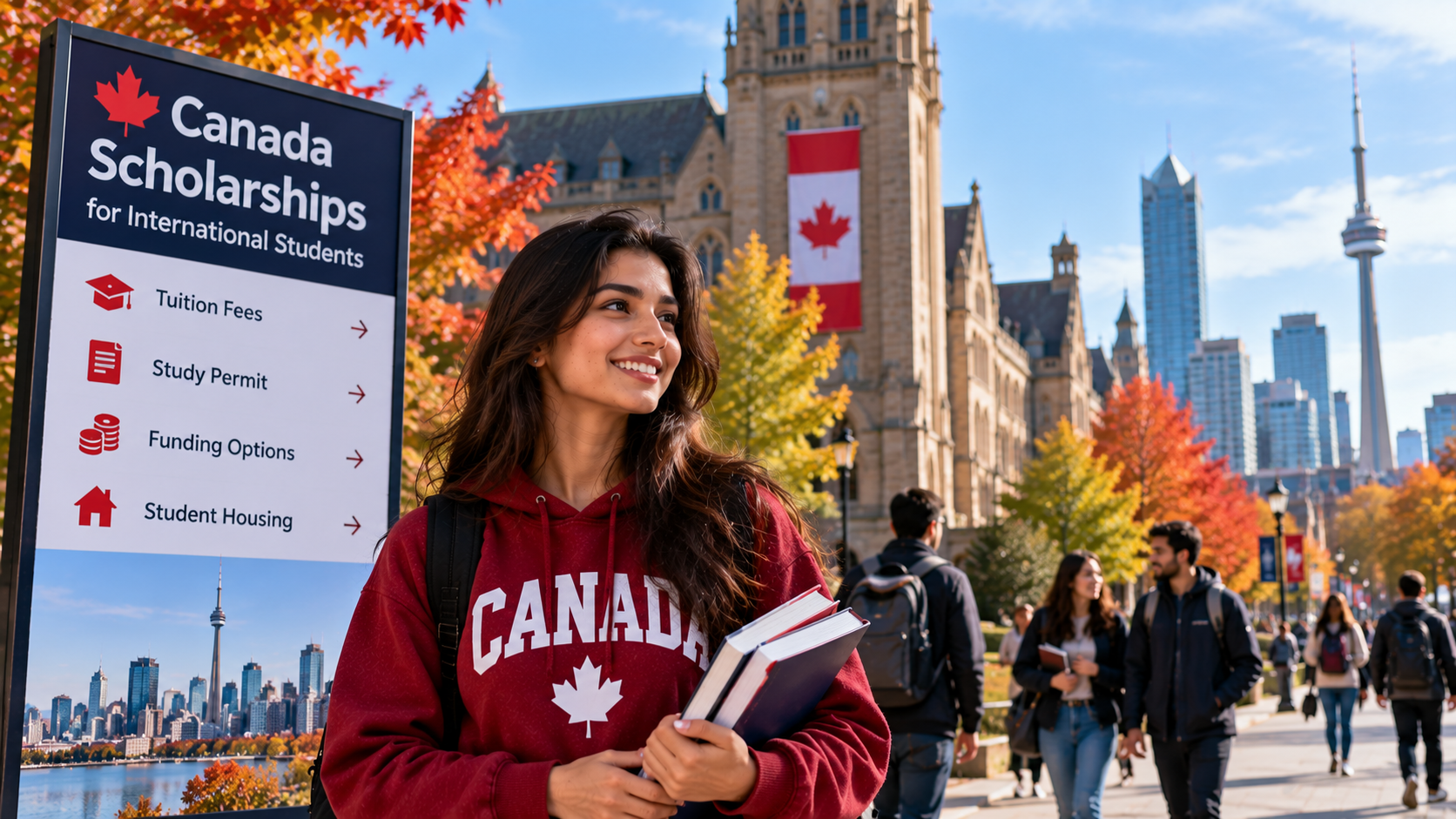
Canada Scholarships for International Students: Tuition Fees, Study Permit, Funding & Student Housing
Canada remains a major destination for international students seeking university scholarships, internationally recognised qualifications, research opportunities, post-graduation work experience, and potential long-term career pathways.
For international students in 2026, however, choosing a Canadian university should begin with the total cost of studying, not simply the tuition fee advertised by the institution.
A realistic education budget may include:
- Tuition
- Mandatory university fees
- Student health insurance
- Housing
- Food
- Books and equipment
- Transportation
- Study permit fees
- Biometrics
- Flights
- Winter clothing
- Mobile service and internet
- Emergency savings
Scholarships can reduce these expenses, but Canadian funding varies dramatically between universities, programs, and study levels.
International students can potentially combine:
- Entrance scholarships
- Merit awards
- Graduate fellowships
- Research assistantships
- Teaching assistantships
- University bursaries
- Government-funded exchange scholarships
- External awards
- Personal or family funds
- Education loans
The strongest strategy is therefore:
program selection → scholarship research → admission → funding comparison → study permit → proof of funds → housing → banking → health insurance → study → authorised employment → post-graduation planning
How Scholarships in Canada Work
Canada does not have one universal scholarship program covering every international student.
Funding comes from several different sources:
- Universities
- Colleges
- Provincial organisations
- Global Affairs Canada
- Research councils
- Foundations
- Private organisations
- Employers
- Home-country governments
Some scholarships cover only a small part of tuition.
Others can provide:
- Full tuition
- Living allowance
- Research expenses
- Airfare
- Health insurance
- Books
- Visa or permit expenses
Always read the award conditions.
A scholarship described as “fully funded” should be checked line by line to determine whether it actually covers your complete cost of attendance.
Government of Canada Scholarship Programs
EduCanada is the Government of Canada’s official platform for international education and scholarships.
Its scholarship search service allows international students, researchers and institutions to identify programs based on nationality and applicant profile.
Programs currently promoted for international applicants include initiatives such as:
- Study in Canada Scholarships
- Emerging Leaders in the Americas Program
- Scholarships and Educational Exchanges for Development
- Other country- or institution-specific opportunities
These programs do not all fund complete Canadian degrees.
Some are specifically designed for short-term study or research exchanges.
Study in Canada Scholarships
The Study in Canada Scholarships program is a Global Affairs Canada initiative supporting eligible international students undertaking short-term study or research in Canada.
For the 2026–27 cycle, the program opened in January 2026 and had a March 31, 2026 institutional application deadline.
Funding can help cover eligible expenses such as:
- Airfare
- Living costs
- Health insurance
- Books and supplies
- Visa or study/work permit fees
depending on the program and duration.
This is important:
international students do not necessarily submit the application themselves.
For several Global Affairs Canada scholarship programs, the Canadian host institution applies on behalf of eligible candidates.
So before preparing an application, confirm:
- Whether you apply directly
- Whether your current institution nominates you
- Whether the Canadian host institution submits the application
University Entrance Scholarships
Canadian universities commonly offer international entrance scholarships.
These can be based on:
- Academic grades
- Leadership
- Community involvement
- Extracurricular activities
- Research potential
- Program-specific achievement
Some scholarships are automatically considered when you apply for admission.
Others require a separate application.
Never assume your university admission application automatically enters you into every scholarship competition.
Create a separate list containing:
| University | Admission Deadline | Scholarship Deadline | Separate Application? | Award Amount |
|---|
This prevents missing an early funding deadline.
Merit-Based Scholarships
Merit awards usually reward academic or extracurricular strength rather than financial need.
Universities may consider:
- High school results
- University GPA
- Standardised test scores where applicable
- Leadership
- Research
- Competitions
- Community service
Some awards are renewable.
If so, check the renewal conditions carefully.
You may need to maintain:
- A minimum GPA
- Full-time status
- A minimum course load
A CAD 20,000 scholarship advertised across four years may actually represent CAD 5,000 per year and may be conditional on continued academic performance.
Graduate Scholarships
Graduate students often have more funding opportunities than undergraduate students.
Potential sources include:
- University graduate fellowships
- Departmental scholarships
- Research grants
- Teaching assistantships
- Research assistantships
- Supervisor funding
For research-focused master’s or PhD programs, your supervisor’s funding can be as important as the university-wide scholarship competition.
Before accepting an offer, ask:
- Is funding guaranteed?
- For how many years?
- Does it cover tuition?
- Is the stipend before or after tuition?
- Is health insurance included?
- Is teaching work required?
- Is summer funding included?
Research Assistantships
Research assistants work on funded university projects.
A package can potentially include:
- Stipend
- Hourly wages
- Tuition support
- Research expenses
depending on the university and grant.
Strong fields for research funding can include:
- Engineering
- Computer science
- Artificial intelligence
- Data science
- Biotechnology
- Public health
- Natural sciences
- Environmental research
Funding varies by professor and department.
Teaching Assistantships
Teaching assistants can help with:
- Tutorials
- Laboratories
- Grading
- Student support
- Course delivery
Compensation may be hourly or packaged as part of graduate funding.
Compare the actual value against your tuition and living expenses.
A CAD 12,000 assistantship does not make a CAD 40,000 annual study cost fully funded.
Scholarship Search Strategy
Do not search only:
fully funded scholarships Canada
This produces many low-quality scholarship websites.
Instead search:
- University name + international scholarships
- Program name + funding
- Faculty name + graduate funding
- Professor + funded MSc/PhD
- EduCanada scholarships
- Government scholarship + your country
Use official university and government pages wherever possible.
Tuition Fees in Canada
There is no universal Canadian tuition fee for international students.
Costs depend on:
- University or college
- Province
- Degree
- Undergraduate vs graduate level
- Professional program
- Course load
Programs such as:
- Medicine
- Dentistry
- MBA
- Engineering
- Computer science
can have very different fee structures.
International tuition is often materially higher than domestic tuition.
When comparing schools, use the exact annual tuition published for your:
program + intake year + international student status
rather than relying on national averages alone.
Calculate the Real Annual Cost
For every university, calculate:
Tuition + mandatory fees + health insurance + housing + food + transport + books − guaranteed funding
Suppose:
University A
Tuition: CAD 32,000
Scholarship: CAD 5,000
Living costs: CAD 18,000
Estimated first-year cost:
CAD 45,000
University B
Tuition: CAD 40,000
Scholarship: CAD 18,000
Living costs: CAD 16,000
Estimated first-year cost:
CAD 38,000
University B appears more expensive before funding but can become significantly cheaper after scholarship support.
Always compare net cost.
Study Permit Requirements
Most foreign nationals coming to Canada for post-secondary education need a study permit.
IRCC currently charges:
CAD 150
for a study permit application.
The applicant generally needs to demonstrate that they:
- Have been accepted by a Designated Learning Institution
- Have sufficient financial resources
- Meet applicable health and character requirements
- Will comply with the conditions of their stay
IRCC states that applicants must demonstrate enough money for:
- Tuition
- Living expenses
- Accompanying family members
- Return transportation
where applicable.
Designated Learning Institution
Your admission should come from a Designated Learning Institution, commonly called a DLI.
The letter of acceptance is a fundamental study permit document.
Do not pay a large non-refundable tuition deposit before checking:
- DLI status
- Program details
- Refund terms
- PGWP eligibility
if post-graduation work is part of your long-term plan.
A school being a DLI does not automatically mean every program at that institution is PGWP eligible.
PAL or TAL Requirement
Many study permit applicants also need a Provincial Attestation Letter or Territorial Attestation Letter, known as a PAL or TAL.
IRCC’s application guidance states that applicants who require one generally need both:
- Letter of Acceptance
- PAL/TAL
before submitting the study permit application.
However, important exemptions apply in 2026.
Master’s and Doctoral Students
From January 1, 2026, students entering eligible master’s or doctoral degree programs at public DLIs are exempt from the PAL/TAL requirement.
Other PAL/TAL-exempt groups include specified:
- Primary and secondary students
- Vulnerable or priority applicants
- Existing permit holders extending at the same DLI and study level
depending on the rules.
Applicants should check the current exemption rules before assuming they need—or do not need—a PAL.
Quebec Students
Quebec has a separate immigration structure.
For many Quebec students, the Certificat d’acceptation du Québec, commonly called a CAQ, interacts with the federal study permit process.
IRCC notes that for students intending to study in Quebec, the CAQ generally serves the PAL/TAL function.
Quebec also has separate financial requirements and processes.
Do not use non-Quebec financial figures blindly for a Montreal study plan.
Proof of Financial Support in 2026
For study permit applications submitted on or after September 1, 2026, IRCC requires a single student studying outside Quebec to demonstrate at least:
CAD 23,448
for first-year living expenses.
This amount excludes:
- Tuition
- Transportation
and applies in provinces and territories outside Quebec.
The current table is:
| Family members, including student | Required living funds |
|---|---|
| 1 | CAD 23,448 |
| 2 | CAD 29,192 |
| 3 | CAD 35,888 |
| 4 | CAD 43,572 |
| 5 | CAD 49,419 |
| 6 | CAD 55,736 |
| 7 | CAD 62,054 |
| Each additional person | + CAD 6,318 |
These amounts exclude tuition and travel.
That distinction is critical.
A single student whose first-year tuition is CAD 30,000 could need to demonstrate access to substantially more than CAD 53,000 when tuition, living funds, and travel are considered together.
What Can Be Used as Financial Evidence?
Depending on circumstances, evidence can include:
- Canadian bank account evidence
- Guaranteed Investment Certificate where applicable
- Education loan documentation
- Bank statements
- Proof tuition has been paid
- Scholarship letter
- Funding letter
- Sponsor documentation
- Other acceptable financial records
IRCC may also require country-specific evidence.
Your financial documents should tell a logical story.
A large unexplained last-minute deposit can create questions.
Scholarships and Proof of Funds
A genuine scholarship can help demonstrate funding.
Your award letter should clearly state:
- Amount
- Duration
- What expenses are covered
- Whether it is renewable
- Conditions attached
If your scholarship covers CAD 15,000 of a CAD 30,000 tuition bill, you still need a credible plan for the remaining:
- CAD 15,000 tuition
- Living funds
- Transportation
Scholarship approval does not automatically remove the study permit financial-support requirement.
Education Loans
International students may use education loans to fill a funding gap where acceptable.
Potential sources include:
- Home-country banks
- Government student-loan programs
- Private international education lenders
Before borrowing, compare:
- Interest rate
- APR or effective financing cost
- Origination fee
- Repayment period
- Moratorium period
- Collateral requirement
- Cosigner
- Currency risk
Borrowing should ideally fill the final gap after scholarships and personal resources rather than funding an unaffordable program entirely through debt.
Currency Risk
Students borrowing in one currency and later earning in Canadian dollars should consider exchange-rate risk.
Likewise, a family earning in another currency can see Canadian tuition become more expensive if the Canadian dollar strengthens.
Keep a buffer rather than calculating finances to the exact minimum required by IRCC.
Canada Study Permit Application Roadmap for 2026
Step 1: Choose Your Degree
Identify whether you want:
- Diploma
- Bachelor’s
- Master’s
- PhD
The level affects:
- Tuition
- Scholarships
- PAL/TAL rules
- PGWP rules
- Career outcomes
Step 2: Choose Your Field
Research both academic value and post-graduation implications.
For non-degree programs, PGWP field-of-study eligibility can be particularly important.
Step 3: Build a University Shortlist
Compare:
- Academic quality
- Tuition
- Scholarships
- City cost
- PGWP eligibility
- Housing
Do not rank universities only by reputation.
Step 4: Confirm DLI Status
Verify the institution and program before paying substantial deposits.
Step 5: Check PGWP Eligibility Before Applying
IRCC specifically advises students interested in post-graduation work to verify whether their DLI and study program meet PGWP requirements before submitting the study permit application.
Step 6: Search Scholarships
Use:
- University funding pages
- EduCanada
- Departmental scholarships
- Faculty research pages
- External organisations
Step 7: Record Scholarship Deadlines
Some funding deadlines occur before normal admission deadlines.
Step 8: Prepare Admission Documents
Common documents can include:
- Transcripts
- Degree certificates
- School results
- English-language test
- CV
- Statement of purpose
- References
Requirements differ by program.
Step 9: Submit Admission Applications
Apply to financially realistic universities, not just dream schools.
Step 10: Apply for Scholarships
Submit separate scholarship forms where required.
Step 11: Compare Offers
Calculate:
First-year tuition + living expenses + insurance − guaranteed scholarships
Do not count scholarships for which you are merely “eligible to apply.”
Step 12: Accept the Best Offer
Check:
- Tuition deposit
- Refund policy
- Scholarship conditions
Step 13: Obtain Your Letter of Acceptance
Make sure the admission is from the correct DLI and program.
Step 14: Obtain PAL/TAL if Required
Most affected applicants need this before submitting the study permit application.
Public master’s and doctoral students are exempt from the PAL/TAL requirement in 2026 under the current rules.
Step 15: Prepare Proof of Funds
For applications on or after September 1, 2026, a single applicant outside Quebec needs CAD 23,448 for living expenses, plus tuition and transportation.
Step 16: Pay the Study Permit Fee
Current study permit application fee:
CAD 150.
Step 17: Complete Biometrics if Required
Pay and complete biometrics according to IRCC instructions.
Step 18: Complete Medical Examination if Required
Some applicants need an immigration medical exam.
Step 19: Submit the Study Permit Application
Make sure financial documents, academic plans and admission details are consistent.
Step 20: Arrange Temporary Housing
Do not arrive without an accommodation strategy.
Step 21: Arrange Health Coverage
Check provincial rules and university insurance requirements.
Step 22: Travel to Canada
Carry important documents in your hand luggage.
Step 23: Open a Canadian Bank Account
Set up:
- Debit card
- Tuition payments
- Rent
- Mobile bills
Step 24: Obtain a SIN if Eligible to Work
You need a Social Insurance Number to legally work in Canada.
Step 25: Begin Your Program and Follow Work Conditions
Eligible international students may work off campus up to 24 hours per week during regular academic sessions.
The complete sequence is:
program → DLI → scholarship → admission → PAL/TAL where required → funding proof → study permit → housing → insurance → banking → study → permitted employment → PGWP planning
Working While Studying in Canada
Eligible students can work off campus without a separate work permit where they meet all applicable conditions.
During regular semesters, the current limit is:
24 hours per week
for eligible students.
During scheduled academic breaks, eligible students can generally work unlimited off-campus hours.
Students must not begin working before their study program starts.
On-Campus Employment
Eligible international students can also work on campus.
IRCC currently states that there is no specific hourly limit on qualifying on-campus employment, provided the student remains eligible.
Possible employers include:
- University
- Faculty members
- Student organisations
- Private campus businesses
- Contractors providing on-campus services
Employment should not replace the funding you were required to demonstrate for your study permit.
Student Work Placements and Co-op
An important 2026 change applies to co-op and internship placements.
From April 1, 2026, eligible post-secondary international students no longer need a separate co-op work permit for qualifying student work placements.
Students should still make sure the placement complies with:
- Program requirements
- Study permit conditions
- Current IRCC rules
Post-Graduation Work Permit
The Post-Graduation Work Permit, or PGWP, can allow qualifying graduates to gain Canadian work experience after completing their program.
Do not assume every Canadian course leads to a PGWP.
General eligibility requires completion of an eligible program at a qualifying DLI and satisfaction of additional requirements.
PGWP Language Requirements
For graduates applying under the current rules:
Bachelor’s, Master’s and Doctoral Graduates
The minimum language requirement is generally:
CLB/NCLC 7
in all four language abilities.
Other College or Non-University Programs
The minimum is generally:
CLB/NCLC 5
where the current requirements apply.
PGWP Field-of-Study Rules
Bachelor’s, master’s and doctoral graduates do not currently need to satisfy a field-of-study requirement.
For many other university, college, polytechnic, and non-university programs where the student applied for a study permit on or after November 1, 2024, the program must fall within an eligible field of study.
Eligible fields are linked to labour shortages and include categories such as:
- Agriculture and agri-food
- Education
- Healthcare and social services
- STEM
- Trades
- Transport
The eligible field list is frozen for 2026, meaning IRCC says no fields will be added or removed during the year.
This should be checked before paying tuition, particularly for diploma and certificate students.
Health Insurance for International Students
Canada does not have one universal national student-health-insurance system for international students.
Coverage depends on:
- Province
- Study permit status
- Length of stay
- University
- College
Some international students may become eligible for provincial health insurance.
Others need:
- University-sponsored health insurance
- Private insurance
Many universities automatically enrol international students in a student health plan unless another approved arrangement applies.
What Health Insurance May Cover
A plan can include:
- Doctor visits
- Hospital treatment
- Emergency services
- Prescription coverage
- Mental-health care
Optional or supplementary plans can include:
- Dental
- Vision
- Physiotherapy
Check the actual policy.
Do not assume “health insurance included” means every medical expense is covered.
Student Housing Options
Housing can become one of the largest expenses after tuition.
International students generally choose between:
- University residence
- Private apartment
- Shared rental
- Homestay
- Furnished short-term accommodation
University Residence
Advantages can include:
- Campus location
- Furnished room
- Utilities included
- Internet
- Easier first-year transition
Disadvantages can include:
- Meal-plan requirements
- Limited privacy
- Limited availability
- Higher cost in some markets
Apply early because residence spaces can fill quickly.
Private Student Housing
Private housing offers more flexibility.
Major Canadian rental platforms include:
- Rentals.ca
- Realtor.ca
- Zumper
- Kijiji
- PadMapper
Students should also use:
- University housing boards
- Verified roommate portals
- Local property managers
Shared Housing
Sharing can substantially reduce costs in expensive cities.
A student may rent:
- Private bedroom
- Shared kitchen
- Shared bathroom
This can be particularly useful in:
- Toronto
- Vancouver
- Ottawa
- Victoria
- Other high-cost markets
Always review:
- Lease
- Utilities
- Deposits
- Furniture
- Commute
before comparing prices.
Housing Cost vs Scholarship Value
Suppose one university offers an extra:
CAD 5,000 scholarship
but its city costs:
CAD 700 more per month
for housing.
Over 12 months:
CAD 700 × 12 = CAD 8,400
The larger scholarship can still leave you financially worse off.
Scholarship comparison should therefore include location.
Choosing a City
Do not choose Canada only by university ranking.
Compare:
- Tuition
- Scholarship
- Rent
- Public transport
- Job market
- Climate
- Housing availability
Toronto and Vancouver can provide large employment markets but often come with higher housing costs.
Smaller cities may provide lower living expenses but fewer part-time or specialised job opportunities.
Rental Documents
Private landlords can request:
- Passport
- Study permit
- University enrolment
- Bank statements
- References
- Guarantor information
International students may not initially have:
- Canadian credit history
- Employment
- Canadian rental references
University housing can therefore be easier during the first year.
Rental Deposits and Provincial Rules
Rental law differs by province.
Do not assume:
- Ontario
- British Columbia
- Alberta
- Quebec
use identical deposit or lease rules.
Check official provincial tenancy guidance before paying a deposit.
Avoid Student Housing Scams
International students are common targets.
Warning signs include:
- Rent far below market
- Landlord refusing a viewing
- Demand for immediate bank transfer
- Cryptocurrency payment
- Copied photos
- No written lease
Verify:
- Address
- Landlord
- Property manager
- Payment instructions
before sending money.
Banking for International Students
Major Canadian banks include:
- RBC
- TD
- Scotiabank
- BMO
- CIBC
- National Bank
Many banks offer newcomer or student account packages.
Compare:
- Monthly fee
- Student fee waiver
- Debit card
- Interac e-Transfer
- ATM access
- International transfers
- Credit card options
Do not choose a bank only because it has a promotional gift.
Check the long-term account cost after the promotion ends.
Fintech and International Transfers
International students may also use services such as:
- Wise
- Wealthsimple
- EQ Bank
- Other eligible digital providers
Product eligibility differs by residency status.
For tuition payments and family transfers, compare:
Exchange rate + FX margin + transfer fee + receiving fee
Building Canadian Credit
Canada’s major credit bureaus include:
- Equifax
- TransUnion
International students usually arrive without an established Canadian credit history.
Some Canadian banks offer student credit cards to qualifying newcomers.
If you receive one:
- Keep utilisation controlled
- Pay on time
- Avoid cash advances
- Avoid unnecessary debt
A good Canadian credit record can later help with:
- Apartments
- Mobile contracts
- Car financing
- Other loans
Education Loans vs Credit Cards
Do not use high-interest credit cards to finance large tuition balances if a lower-cost education loan is available.
Compare:
- Interest
- Fees
- Repayment term
- Currency
- Total borrowing cost
Credit cards are generally better suited to manageable short-term spending than multi-year tuition financing.
Mobile Service
Major Canadian mobile brands include:
- Rogers
- Bell
- TELUS
- Freedom Mobile
- Fido
Students can compare:
- Prepaid
- Monthly contract
- eSIM
- Data
- International calls
Prepaid service can be easier immediately after arrival if you have limited Canadian credit history.
Broadband and Internet
University residence may include internet.
Private renters may need a separate plan.
Major providers vary by province but can include:
- Bell
- Rogers
- TELUS
- Regional providers
Check:
- Speed
- Installation
- Router
- Promotion duration
- Regular price
Utilities
Depending on the lease, students may separately pay:
- Electricity
- Natural gas
- Heating
- Water
- Internet
Always ask the landlord:
“Which utilities are included in the rent?”
before signing.
Taxes and Student Employment
International students working in Canada may have tax obligations.
Keep:
- Pay statements
- T4 slips
- Scholarship records
- Tuition documents
Tax treatment of scholarships and employment depends on individual circumstances.
Social Insurance Number
Eligible international students need a Social Insurance Number, or SIN, to work in Canada.
Your study permit must contain the appropriate employment conditions before Service Canada can issue the SIN for student employment.
Do Not Depend on Part-Time Work to Pay Tuition
The 24-hour weekly off-campus allowance is useful, but it should not be treated as a replacement for proper financial preparation.
IRCC requires proof that applicants can finance their education and living costs before being approved.
Part-time income is better viewed as support for:
- Food
- Mobile
- Transport
- Personal expenses
rather than your main strategy for paying international tuition.
Complete Canada Study Budget
Before Admission
Possible expenses:
- English test
- Application fees
- Transcript delivery
- Document translation
After Admission
Prepare for:
- Tuition deposit
- PAL/TAL where applicable
- Study permit fee
- Biometrics
- Medical examination
- Housing deposit
First-Year Funding
For applications from September 1, 2026, outside Quebec:
CAD 23,448 living requirement for one person
plus:
- Tuition
- Transportation
must be considered.
Arrival
Budget for:
- Flight
- Airport transfer
- Temporary accommodation
- Food
- Winter clothing
- Mobile service
Academic Year
Budget for:
- Remaining tuition
- Rent
- Health insurance
- Food
- Transport
- Books
- Internet
- Personal expenses
Maintain an emergency reserve wherever possible.
Scholarship Renewal
If your scholarship lasts more than one year, understand its renewal terms.
Ask:
- Minimum GPA?
- Full-time enrolment?
- Maximum number of years?
- Does tuition inflation affect the award?
- Does the scholarship increase annually?
A fixed CAD 10,000 annual scholarship becomes proportionally less valuable if tuition increases substantially.
Permanent Residence Should Not Drive a Poor Study Decision
Many students consider Canada partly because they hope to gain Canadian work experience and eventually pursue permanent residence.
That is understandable, but immigration rules change.
Select a program primarily because it offers:
- Academic value
- Employable skills
- Affordable total cost
- Legitimate PGWP potential
Do not borrow an unsustainable amount solely because someone claims the course “guarantees PR.”
No Canadian college or recruiter can guarantee permanent residence.
Frequently Asked Questions
Can international students get scholarships in Canada?
Yes. Funding can come from universities, colleges, Global Affairs Canada programs, research departments, foundations and other organisations. EduCanada provides an official search tool for international scholarship opportunities.
Does Canada offer fully funded scholarships?
Some awards can provide substantial or comprehensive support, particularly in graduate research, but benefits vary. Always verify whether tuition, living costs, insurance and travel are actually included.
What is the Canada study permit fee in 2026?
The current study permit application fee is CAD 150.
How much proof of funds does a single student need?
For applications submitted on or after September 1, 2026, a single applicant outside Quebec needs CAD 23,448 for living expenses, excluding tuition and transportation.
Do I need a PAL or TAL?
Many students do, but exemptions exist. From January 1, 2026, eligible master’s and doctoral students at public DLIs are exempt from the PAL/TAL requirement.
Can a scholarship count toward proof of funds?
A legitimate scholarship or funding award can form part of your financial evidence, but you must still demonstrate how all remaining tuition, living and travel costs will be covered.
Can international students work while studying?
Eligible international students can currently work up to 24 hours per week off campus during regular academic sessions and unlimited hours during eligible scheduled breaks.
Do students need a separate co-op work permit in 2026?
From April 1, 2026, eligible post-secondary international students no longer need a separate co-op work permit for qualifying student work placements.
Does every Canadian course qualify for a PGWP?
No. Students should verify both the DLI and program before enrolling. Additional language and field-of-study rules may apply.
Are bachelor’s and master’s programs subject to the PGWP field-of-study restriction?
Bachelor’s, master’s and doctoral graduates do not currently need to meet the field-of-study requirement, although other PGWP eligibility requirements still apply.
Which Canadian banks are popular with international students?
Common options include RBC, TD, Scotiabank, BMO, CIBC and National Bank.
Is student housing guaranteed?
No. University residence capacity can be limited, and private housing availability varies considerably by city. Apply for housing early.
Final Thoughts
Canada can provide excellent opportunities for international students, but a successful application requires much more than securing admission.
The strongest strategy combines:
a reputable academic program + realistic tuition + genuine scholarship funding + sufficient study permit funds + affordable housing + PGWP awareness + controlled borrowing
Government scholarship opportunities can be researched through EduCanada, while universities and research departments provide additional merit scholarships, assistantships and fellowships.
For study permit applications submitted on or after September 1, 2026, a single student studying outside Quebec currently needs to demonstrate CAD 23,448 in first-year living funds, excluding tuition and transportation. The study permit itself currently costs CAD 150.
Applicants should also understand Canada’s changing international-student framework. Eligible students can currently work up to 24 hours per week off campus during academic sessions, public-DLI master’s and doctoral students are exempt from PAL/TAL requirements in 2026, and PGWP eligibility now depends more heavily on program type, language ability and—in some non-degree programs—field of study.
The clearest 2026 application roadmap is:
choose your program → verify the DLI and PGWP eligibility → calculate total tuition and living costs → search scholarships → apply for admission → secure funding → obtain the Letter of Acceptance → obtain PAL/TAL where required → prepare tuition plus CAD 23,448 living funds → apply for the study permit → arrange health insurance → secure temporary or student housing → travel to Canada → open a bank account → obtain a SIN if eligible → begin studies → use authorised employment responsibly → maintain scholarship conditions → prepare for PGWP where eligible
The best Canadian scholarship is therefore not simply the award with the largest headline amount.
The strongest offer is the one that leaves you with the lowest sustainable total cost while preserving academic quality, housing affordability, valid immigration status, manageable debt, and realistic post-graduation opportunities.