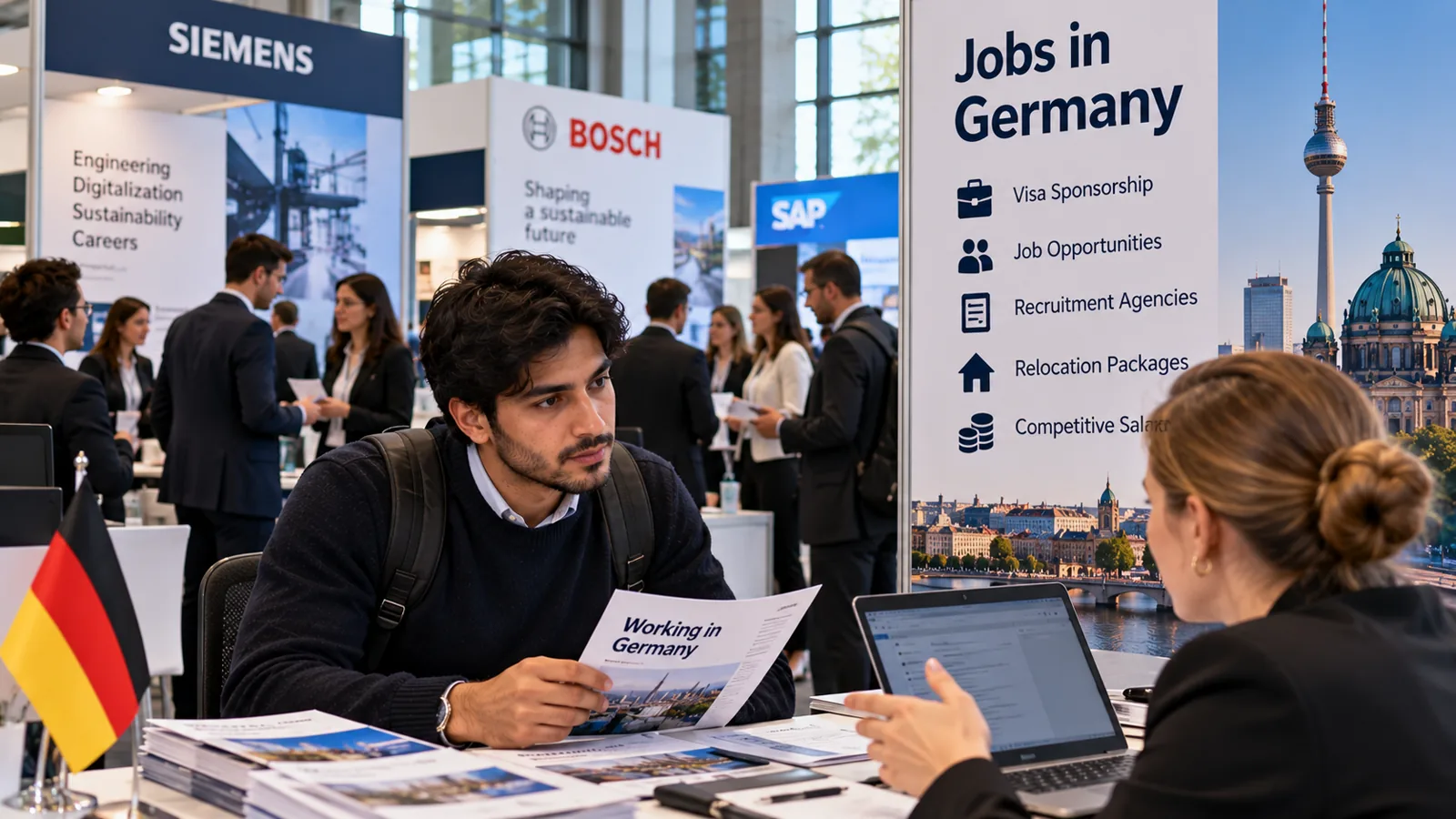
Germany Jobs for International Workers: Visa Sponsorship, Salaries, Recruitment Agencies & Relocation Packages
Germany Jobs for International Workers: Visa Sponsorship, Salaries, Recruitment Agencies & Relocation Packages
Germany remains one of Europe’s most important destinations for skilled international workers, particularly in IT, engineering, healthcare, manufacturing, construction, logistics, science, education, and technical professions.
For foreign workers, however, getting hired in Germany is not simply about finding an employer willing to “sponsor” a visa. Germany’s system is different from countries where employer sponsorship is the central immigration concept.
Depending on your qualifications and job, you may qualify through routes such as the EU Blue Card, work visa for qualified professionals, employment based on professional experience, Opportunity Card, or occupation-specific pathways. The employer normally provides the employment contract or binding job offer needed for the immigration process, while the German authorities determine whether the residence title can be issued.
For the EU Blue Card in 2026, the standard annual gross salary threshold is €50,700. A reduced threshold of €45,934.20 applies to qualifying shortage occupations and certain recent graduates, subject to the applicable conditions.
Germany also allows qualifying workers with substantial professional experience to access certain non-regulated occupations without completing full German recognition first. For that route, the 2026 job offer must generally provide at least €45,934.20 gross per year, alongside the required qualifications and professional experience.
That makes salary, qualification recognition, job classification, language ability, and immigration route equally important when evaluating an offer.
International workers should also prepare for the wider relocation journey:
job search → employment contract → visa → temporary accommodation → German registration → salary account → SCHUFA profile → permanent rental → insurance → utilities → international money transfers → long-term residence → possible home ownership
How Germany “Visa Sponsorship” Works
The phrase visa sponsorship is commonly used by international applicants, but German employment immigration does not always operate through a formal employer-sponsored visa system in the same way as the UK or United States.
The employer usually provides:
- Employment contract
- Job description
- Salary information
- Working hours
- Employer declarations required for immigration
- Supporting information for Federal Employment Agency approval where necessary
The worker then applies for the appropriate visa or residence permit.
For many third-country nationals, the Federal Employment Agency may need to approve the employment. Approval generally considers whether there is a concrete job offer and whether the employment conditions are comparable with those offered to domestic workers.
Workers from EU and EEA countries and Switzerland generally have broader freedom to work in Germany without going through the same third-country visa procedure.
Main German Work Visa Routes in 2026
EU Blue Card
The EU Blue Card is one of the most attractive routes for highly qualified professionals.
For 2026:
- Standard salary threshold: €50,700 gross annually
- Reduced threshold for qualifying shortage occupations and certain recent graduates: €45,934.20
Shortage occupations can include qualifying roles in areas such as:
- Mathematics
- IT
- Engineering
- Architecture
- Healthcare
- Education
- Science
- Certain management occupations
The position should also appropriately match the applicant’s qualification.
For experienced international professionals earning above the threshold, the Blue Card can be an attractive route because it also offers a relatively structured path toward long-term residence.
Work Visa for Qualified Professionals
Germany also has a residence route for qualified professionals with recognised or comparable academic or vocational qualifications.
This can be relevant to:
- Engineers
- Skilled tradespeople
- Healthcare professionals
- Technical workers
- Business professionals
- Other qualified employees
Recognition requirements depend on the occupation.
For regulated professions, such as many healthcare occupations, formal professional recognition can be mandatory.
For many non-regulated occupations, the rules can be more flexible.
Employment Based on Professional Experience
Germany’s Skilled Immigration Act expanded access for workers with strong professional experience.
For qualifying non-regulated professions, applicants may be able to work without first completing formal German recognition if they have:
- A qualification recognised by the country where it was obtained
- At least two years of qualifying vocational education where relevant
- At least two years of professional experience
- A qualifying German job offer
For 2026, the salary attached to this route must generally reach at least €45,934.20 gross annually.
This route can be especially valuable for experienced professionals who have practical expertise but face lengthy German recognition procedures.
Opportunity Card
The Opportunity Card can allow qualifying applicants to enter Germany for job-search purposes rather than requiring a full employment contract before arrival.
It can be useful for people who meet the relevant qualification, financial, language, or points requirements.
However, obtaining an Opportunity Card does not guarantee employment.
Applicants should still arrive with:
- An employment strategy
- Several months of living funds
- Temporary housing
- A professional German CV
- Interview preparation
- Clear target occupations
If you can secure a qualified job from abroad, that may be financially safer than moving first and searching later.
Which Germany Jobs Are Best for International Workers?
Software and IT Jobs
Germany continues to recruit international professionals for roles including:
- Software Developer
- Software Engineer
- Backend Engineer
- Cloud Engineer
- DevOps Engineer
- Cybersecurity Specialist
- Data Engineer
- AI Engineer
- Machine Learning Engineer
- SAP Consultant
- IT Project Manager
StepStone’s 2026 salary data places the median salary for a Software Engineer at approximately €52,800 gross annually, with its displayed range around €46,500 to €64,500.
This is particularly relevant for immigration because many experienced software professionals can reach or exceed the current EU Blue Card threshold.
International applicants should prioritise employers offering salaries that satisfy both market expectations and their intended visa route.
Engineering Jobs
Germany’s manufacturing and industrial base creates strong demand for engineering talent.
Potential roles include:
- Mechanical Engineer
- Electrical Engineer
- Automotive Engineer
- Civil Engineer
- Industrial Engineer
- Mechatronics Engineer
- Process Engineer
- Automation Engineer
- Robotics Engineer
StepStone currently places Mechanical Engineer compensation around a €54,500 median, with its reported range approximately €46,200 to €64,600.
Large engineering employers may offer additional benefits including:
- Relocation assistance
- Temporary accommodation
- Language courses
- Visa support
- Recognition assistance
Healthcare Jobs
Germany also recruits international:
- Doctors
- Nurses
- Physiotherapists
- Medical technicians
- Pharmacists
- Care professionals
Healthcare jobs can involve stricter professional recognition and German-language requirements because many positions are regulated.
A foreign nurse or doctor should not assume that obtaining a job offer is sufficient.
Professional recognition may be necessary before unrestricted employment can begin.
Skilled Trades
Germany’s labour market also includes opportunities for qualified workers in:
- Electrical trades
- HVAC
- Industrial maintenance
- Welding
- Construction
- Mechanical trades
- Manufacturing
Visa eligibility depends on the worker’s training, experience, employer, salary, and whether recognition is required.
Applicants should verify the occupation rather than assuming that every shortage automatically creates visa eligibility.
Logistics and Manufacturing
Major German industries recruit workers for roles in:
- Supply chain
- Industrial production
- Warehouse management
- Production supervision
- Logistics engineering
- Quality management
International recruitment tends to be stronger for skilled and specialist positions than for generic low-skilled work.
Research and University Jobs
Germany’s universities and research institutions employ international candidates as:
- Researchers
- Postdoctoral fellows
- Professors
- Scientific employees
- Engineers
- Laboratory specialists
- Data scientists
- Project coordinators
Research institutions can offer especially structured immigration and relocation support.
Major Employers to Research
Germany has thousands of employers, but large international organisations can be useful starting points.
Potential employers include:
- Siemens
- Bosch
- SAP
- BMW
- Mercedes-Benz
- Volkswagen
- Deutsche Telekom
- Allianz
- BASF
- Bayer
- Deutsche Bank
- Commerzbank
- Infineon
- DHL Group
- Continental
This does not mean every vacancy at these organisations supports an overseas hire.
Applicants should check the individual job description.
Recruitment Agencies and Official Job Support
Germany has both public employment support and private recruitment agencies.
The safest starting point for international applicants is the Federal Employment Agency, or Bundesagentur für Arbeit.
Its international services provide job-search support to people living outside Germany and describe the advice as personalised and free of charge.
Official vacancy resources include:
- Make it in Germany
- Federal Employment Agency job search
- EURES
The Federal Employment Agency explicitly recommends these channels for people searching from abroad.
ZAV: Germany’s International Recruitment Service
The Zentrale Auslands- und Fachvermittlung, commonly known as ZAV, is the Federal Employment Agency’s specialist service for international labour mobility.
It supports both:
- German employers recruiting internationally
- Foreign skilled workers interested in Germany
The ZAV works with domestic and international partners and forms an important connection between Germany and EURES.
For international applicants, official ZAV support can be preferable to paying an unknown recruitment agency upfront.
Private Recruitment Agencies
Private agencies can help with:
- Employer matching
- CV preparation
- Interviews
- Relocation
- Recognition procedures
However, Germany’s official Make it in Germany portal warns that it does not itself provide commercial job-placement services. Private recruiters claiming to represent the portal should therefore be treated cautiously.
Before paying a recruiter:
- Verify the company
- Review its contract
- Check fees
- Confirm the employer independently
- Never pay for a guaranteed visa
- Never accept a fake employment contract
The Federal Employment Agency’s own international placement services are free.
Recruitment vs UK Sponsorship
Workers comparing Germany with Britain should understand that the two systems are structured differently.
The UK relies heavily on licensed sponsors and employer-issued Certificates of Sponsorship, while Germany more often focuses on the combination of your qualification, employment contract, salary, occupation, and residence category.
If you’re deciding between the two destinations, this guide to UK visa sponsorship jobs for foreign workers explains the UK employer-sponsorship model, approved employers, salaries, and relocation benefits in more detail.
How to Find Germany Jobs From Abroad
Officially recommended platforms include:
- Make it in Germany
- Federal Employment Agency
- EURES
You can also use:
- StepStone
- Indeed Germany
- Employer career websites
- Industry-specific portals
Search in both English and German.
Examples:
Software Engineer Germany EnglishIngenieur international applicantsVisa support Germany jobsRelocation Germany software engineerEnglish speaking jobs BerlinFachkraft internationale Bewerber
Do not limit yourself to advertisements containing “visa sponsorship.”
Many German employers use phrases such as:
- Relocation support
- International candidates welcome
- Visa support
- Immigration assistance
- Global mobility
German Language Requirements
German requirements vary substantially.
Some multinational IT, engineering, scientific, and research roles operate mainly in English.
German can be more important for:
- Healthcare
- Education
- Skilled trades
- Customer service
- Public administration
- Local business functions
Even if a job allows English, German can improve:
- Housing search
- Government appointments
- Banking
- Workplace integration
- Promotion opportunities
Applicants should view language as a long-term career asset rather than only a visa requirement.
Qualification Recognition
Before applying, determine whether the profession is:
Regulated
Formal recognition or a professional licence may be required.
Examples can include certain:
- Medical occupations
- Healthcare roles
- Teaching positions
Non-Regulated
Formal recognition may not always be legally necessary for employment, although immigration authorities can still need evidence of the qualification.
Useful resources include:
- Recognition in Germany
- Anabin
- ZAB
Start recognition early if your profession needs it.
Germany Salary Comparison for International Workers
Salary should be considered before accepting an offer because Germany’s major cities vary significantly in housing costs.
Illustrative 2026 market data includes:
| Role | Approximate Market Indicator |
|---|---|
| Software Engineer | €52,800 median |
| Software Developer | €51,400 median |
| Mechanical Engineer | €54,500 median |
StepStone’s 2026 data reports these figures as gross annual salary indicators, not guaranteed employer offers.
Experienced professionals, managers, highly specialised engineers, AI professionals, senior developers, or finance specialists can earn substantially more.
When comparing an offer, evaluate:
Gross salary − tax/social contributions − housing − transport − insurance − utilities
instead of comparing gross salary alone.
Relocation Packages
Large employers may offer relocation support.
Packages can include:
- Visa assistance
- Immigration adviser
- Recognition support
- Flight reimbursement
- Temporary accommodation
- Moving allowance
- International shipping
- Language courses
- Family relocation assistance
- Registration support
Germany’s Federal Employment Agency notes that in some international recruitment projects employers generally cover services such as language preparation, travel, and visa costs, although arrangements vary and project funding can differ.
Never assume these benefits are included.
Before accepting the offer, ask:
- Is airfare reimbursed?
- Is temporary housing provided?
- Are visa fees covered?
- Is family relocation included?
- Does the employer pay for qualification recognition?
- Is German-language training included?
Get the agreement in writing.
Clear 2026 Germany Job Application Roadmap
Step 1: Choose Your Target Profession
Identify roles that genuinely match your:
- Qualification
- Experience
- Technical skills
- Language ability
A focused candidate is easier for an employer to evaluate.
Step 2: Check Whether the Profession Is Regulated
Determine whether formal German recognition is required.
Start early if it is.
Step 3: Compare Immigration Routes
Check whether you fit:
- EU Blue Card
- Qualified-professional visa
- Professional-experience route
- Opportunity Card
- Another specific residence category
Step 4: Check Salary Eligibility
For the 2026 EU Blue Card, compare your offer with:
- €50,700 standard threshold
- €45,934.20 reduced qualifying threshold
Do not assume the reduced threshold applies automatically.
Step 5: Prepare a German-Style CV
Keep your CV:
- Clear
- Chronological
- Role-specific
- Achievement focused
Include:
- Education
- Work history
- Technical skills
- Languages
- Certifications
Step 6: Prepare Qualification Documents
Collect:
- Degrees
- Diplomas
- Transcripts
- Employment certificates
- Professional licences
- Certified translations where necessary
Step 7: Search Official Platforms First
Use:
- Make it in Germany
- Federal Employment Agency
- EURES
The Federal Employment Agency can also provide international applicants with free guidance on job search and applications.
Step 8: Apply Directly to Employers
Use official career pages whenever possible.
Track:
- Company
- Role
- City
- Salary
- Language
- Relocation support
- Application date
Step 9: Prepare for Interviews
Be ready to explain:
- Your experience
- Why Germany
- Technical skills
- Language ability
- Relocation readiness
Step 10: Review the Employment Offer
Check:
- Gross annual salary
- Working hours
- Probation
- Location
- Contract term
- Benefits
- Relocation support
Step 11: Confirm the Immigration Route
Match the final offer with the visa requirements.
Step 12: Complete Recognition if Required
Do not delay professional recognition for regulated occupations.
Step 13: Apply for the Visa
Prepare the official documents required for your specific residence category.
Step 14: Arrange Temporary Housing
Book enough temporary accommodation to allow time for:
- Anmeldung
- Bank account
- Property search
Step 15: Travel to Germany
Keep your:
- Employment contract
- Visa
- Accommodation details
- Insurance evidence
- Qualification documents
accessible.
Step 16: Complete Address Registration
After moving into qualifying accommodation, complete the required local registration procedures.
Registration documentation becomes important for many later services.
Step 17: Open a German Bank Account
Set up salary payments and SEPA direct debits.
Step 18: Start Payroll and Keep Payslips
Your employment records help later with:
- Renting
- Credit
- Financing
- Residence applications
Step 19: Find Permanent Accommodation
Once you understand your commute and monthly budget, move from temporary housing to a longer tenancy.
Step 20: Build a Stable Financial Profile
Pay:
- Rent
- Utilities
- Telecom
- Credit obligations
on time and protect your SCHUFA record.
The practical roadmap is:
occupation → qualification → visa route → salary check → applications → interview → employment contract → visa → temporary accommodation → registration → bank account → payroll → permanent rental → financial profile → long-term residence
Temporary Housing in Germany
New workers should consider temporary accommodation for the first few weeks.
Options include:
- Serviced apartments
- Aparthotels
- Furnished apartments
- Shared rooms
- Corporate housing
- Employer accommodation
International relocators may know brands such as SACO, Staycity, and Cheval Collection, but availability in Germany depends on city and should be checked rather than assumed.
Local furnished accommodation can be especially useful before obtaining all the documents landlords expect.
Finding Permanent Rentals
Major German housing platforms include:
- ImmobilienScout24
- Immowelt
- WG-Gesucht
- Kleinanzeigen
ImmobilienScout24
Useful for:
- Apartments
- Houses
- Agent listings
- Private rentals
Immowelt
Another major property marketplace.
WG-Gesucht
Particularly useful for:
- Shared apartments
- Rooms
- Temporary accommodation
- WGs
Kleinanzeigen
Offers many private listings, but tenants should use stronger scam precautions.
UK platforms such as Rightmove, Zoopla, SpareRoom, and OpenRent are not substitutes for Germany’s domestic housing platforms.
German Rental Costs and Terminology
Important terms include:
Kaltmiete
Base rent before many additional operating costs.
Warmmiete
Rent including specified operating expenses.
Nebenkosten
Additional building-related charges.
Kaution
Security deposit.
Always compare Warmmiete, electricity, internet, insurance, and transport rather than looking only at Kaltmiete.
Rental Documents for International Workers
Landlords may request:
- Passport
- Residence documentation
- Employment contract
- Payslips
- Bank statements
- SCHUFA information
A newcomer may initially have no established SCHUFA record.
A strong employment contract and proof of income can therefore be particularly valuable.
Rental Guarantors
Some landlords may ask for additional security where local credit history is limited.
Possible solutions can include:
- Guarantor
- Stronger proof of income
- Employer documentation
UK professional guarantor companies such as Housing Hand, UK Guarantor, and Guarantid are UK-oriented examples and should not be assumed to provide standard German rental guarantees.
Banking in Germany
Major German banking providers include:
- Deutsche Bank
- Commerzbank
- DKB
- ING Germany
- Sparkasse
- N26
Digital and international options can also include:
- Revolut
- Wise for international transfers
Compare:
- Monthly account fee
- Debit card
- ATM access
- Branch service
- SEPA payments
- International transfers
- Mobile banking
Traditional banks such as Barclays, HSBC, and Lloyds may be familiar to workers relocating from Britain, but German domestic banking services operate differently.
SCHUFA and Credit History
SCHUFA is one of Germany’s major credit-information systems.
A clean German financial history can matter when applying for:
- Rentals
- Credit cards
- Personal loans
- Telecom contracts
- Mortgages
International credit history does not automatically become a German SCHUFA profile.
Build your record by:
- Paying bills on time
- Avoiding defaults
- Keeping information accurate
- Avoiding unnecessary borrowing
Credit Cards
Credit cards are available in Germany, although everyday banking also relies heavily on debit cards and SEPA payments.
Compare:
- Annual fee
- Interest rate
- Foreign transaction fee
- Credit limit
- Eligibility
Newcomers may initially have more limited credit options.
Personal Loans
Before taking a loan for relocation expenses, compare:
- APR
- Monthly payment
- Loan term
- Total repayment
- Early repayment conditions
Your employer’s relocation package should be checked before borrowing for:
- Furniture
- Moving
- Transport
- Initial housing
Debt Management
Continue budgeting for obligations outside Germany, including:
- Student loans
- Credit cards
- Mortgages
- Personal loans
Foreign debt may not appear fully in local credit data, but it still reduces your monthly disposable income.
Insurance in Germany
Major providers include:
- Allianz
- AXA
- HUK-COBURG
- ERGO
International workers may consider:
- Personal liability insurance
- Household contents insurance
- Legal protection where suitable
Compare:
- Premium
- Deductible
- Coverage limits
- Exclusions
UK insurers such as Aviva, Direct Line, Admiral, and Urban Jungle should not be assumed to offer the same German products.
International Money Transfers
Common options include:
- Wise
- Revolut
- OFX
- Banks
Compare:
Exchange rate + FX margin + transfer fee + receiving charges
This matters when transferring:
- Relocation savings
- Rental deposits
- Family money
- Salary
Large transfers can require source-of-funds evidence.
Keep:
- Salary statements
- Bank statements
- Employment contract
Mobile and eSIM
Major German networks include:
- Deutsche Telekom
- Vodafone Germany
- O2
- 1&1
Compare:
- Prepaid SIM
- Monthly contract
- eSIM
- Data
- Roaming
- International calling
Newcomers may find prepaid plans easier before establishing local credit history.
Broadband
Major providers include:
- Deutsche Telekom
- Vodafone
- O2
- 1&1
Depending on the property, available technology can include:
- Fiber
- Cable
- DSL
Compare:
- Monthly fee
- Speed
- Router
- Installation
- Contract term
- Cancellation conditions
Always check the specific property address.
Utilities
A German rental can involve payments for:
- Electricity
- Heating
- Gas
- Water
- Internet
Some costs may already be included in Nebenkosten, while others require separate contracts.
Take meter readings when moving in where applicable.
Tax and Payroll
Employees normally receive German salary through payroll.
Keep:
- Payslips
- Employment contract
- Annual tax documents
- Insurance records
Your actual net salary depends on factors including:
- Gross income
- Tax class
- Social contributions
- Personal circumstances
International workers with:
- Overseas income
- Foreign investments
- Property abroad
may need professional cross-border tax advice.
Legal and Tenancy Support
Before signing a German rental contract, confirm:
- Kaltmiete
- Warmmiete
- Deposit
- Utilities
- Lease length
- Notice terms
- Furniture
- Inventory
Germany does not use the UK’s Deposit Protection Service, MyDeposits, or Tenancy Deposit Scheme as its national rental-deposit framework.
Do not apply UK tenancy rules to a German lease.
Avoid Recruitment Scams
Warning signs include:
- Guaranteed work visa
- Guaranteed EU Blue Card
- Recruitment only through WhatsApp
- Large upfront placement fee
- Fake employer email
- Cryptocurrency payment
- No interview
- Salary inconsistent with the role
The official Make it in Germany portal specifically warns applicants about private organisations implying that they represent the government portal.
Use official channels first.
Avoid Rental Scams
Be cautious of:
- Extremely cheap apartments
- Remote landlord stories
- Advance transfers before verification
- Fake property photographs
- Copied advertisements
- Pressure to pay immediately
Verify:
- Property
- Landlord
- Contract
- Payment instructions
before transferring a deposit.
International Moving
Compare:
- Excess baggage
- Air freight
- Sea freight
- International movers
- Corporate relocation
Ask for several quotes.
Compare:
- Volume
- Weight
- Packing
- Insurance
- Customs
- Delivery time
- Storage
Employer-funded relocation can significantly reduce these costs.
Storage
Temporary storage can be useful while living in furnished accommodation.
Compare:
- Monthly storage fee
- Insurance
- Access
- Minimum term
- Security
- Pickup and delivery
Preparing for Home Ownership
Workers planning to stay in Germany long term may eventually consider purchasing property.
Potential mortgage providers include:
- Deutsche Bank
- Commerzbank
- ING Germany
- Sparkasse
- Regional banks
Lenders can consider:
- Employment stability
- Income
- SCHUFA
- Existing debt
- Deposit
- Residence status
- Property value
Compare:
- Interest rate
- Fixed-interest period
- Repayment structure
- Loan-to-value
- Fees
New arrivals generally benefit from establishing stable employment and local financial history before seeking a mortgage.
Frequently Asked Questions
Can foreign workers get jobs in Germany with visa support?
Yes. International professionals can qualify for several German work-residence routes when they have the required job, qualifications, salary, and other immigration conditions.
What is the EU Blue Card salary requirement in Germany in 2026?
The general threshold is €50,700 gross annually. A reduced €45,934.20 threshold applies in qualifying shortage occupations and for certain recent graduates under the applicable rules.
Do German employers need a sponsorship licence like UK employers?
Not in the same way. Germany generally focuses on the employment contract, occupation, qualification, salary, and immigration route rather than a UK-style licensed-sponsor system.
Can I work in Germany without full qualification recognition?
For some non-regulated jobs, qualifying workers with substantial professional experience can use routes that do not require full German recognition before employment. The rules differ by occupation.
Which official agency helps international workers find jobs?
The German Federal Employment Agency and its international services provide free support to people seeking employment from abroad.
What is ZAV?
ZAV is the Federal Employment Agency’s specialist international labour-market and placement service.
What is the average Software Engineer salary in Germany?
StepStone currently reports approximately €52,800 gross per year as its median figure for Software Engineers.
What does a Mechanical Engineer earn?
StepStone currently reports a median of approximately €54,500 gross annually, with salary varying by experience, employer, and location.
Do I need German language skills?
It depends on the job. Some multinational IT and research positions operate mainly in English, while healthcare, skilled trades, customer-facing, and many local roles can require German.
Which websites should I use to find jobs?
Start with Make it in Germany, the Federal Employment Agency, EURES, employer career websites, LinkedIn, and established German recruitment platforms.
Which German banks should newcomers compare?
Common options include Deutsche Bank, Commerzbank, DKB, ING Germany, Sparkasse, and N26.
Can foreign workers eventually buy property in Germany?
Potentially yes. Mortgage eligibility depends on income, employment, residence status, credit profile, deposit, and lender policy.
Final Thoughts
Germany offers international workers several realistic routes into one of Europe’s largest labour markets, but successful applicants should understand that visa sponsorship, salary, qualification recognition, and employer support are interconnected rather than interchangeable.
For the 2026 EU Blue Card, the key salary figures are currently €50,700 for the standard threshold and €45,934.20 for qualifying shortage occupations and certain recent graduates.
Experienced workers in qualifying non-regulated professions can also potentially use the professional-experience route, where the 2026 salary requirement is generally €45,934.20 and other qualification and experience requirements apply.
Germany also provides unusually strong official recruitment infrastructure. The Federal Employment Agency offers free international job-search support, while ZAV specialises in international labour mobility and recruitment.
The clearest 2026 application roadmap is:
choose your profession → check recognition → select the visa route → verify salary eligibility → prepare a German-style CV → search official job portals → apply directly → interview → negotiate relocation benefits → secure the employment contract → apply for the visa → arrange temporary accommodation → complete registration → open a bank account → start payroll → find permanent housing → build your SCHUFA profile → plan long-term residence
A successful move should be evaluated as a complete financial decision rather than only a job offer.
Compare salary, visa eligibility, rent, taxes, insurance, relocation assistance, banking, credit, utilities, transport, moving costs, and long-term career prospects before accepting an offer.