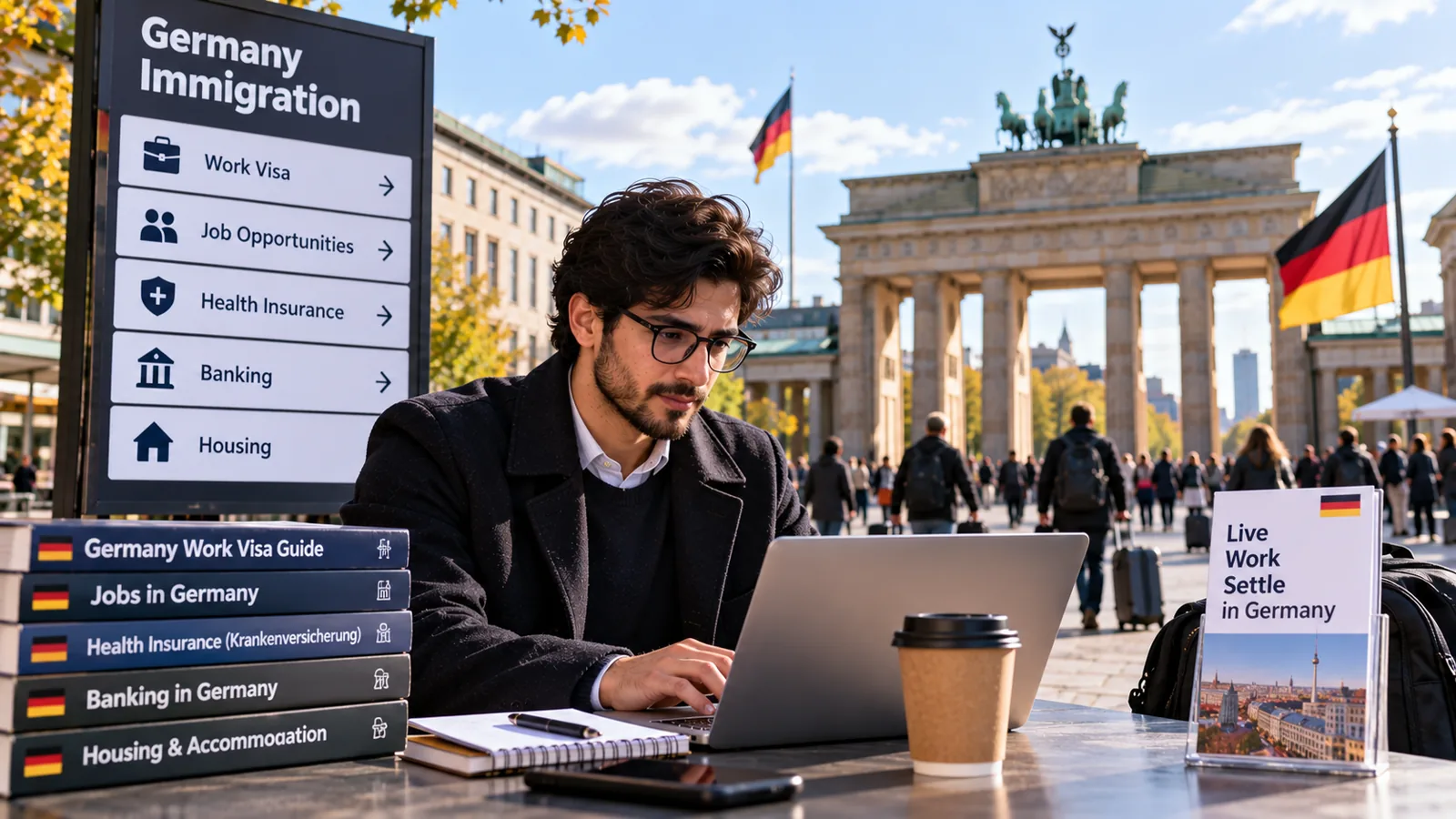
Germany Immigration for Skilled Professionals: Work Visa, Jobs, Health Insurance, Banking & Housing
Germany continues to attract international professionals in engineering, information technology, healthcare, science, manufacturing, skilled trades, logistics, finance, research, renewable energy, and advanced industrial occupations.
For skilled workers from outside the EU, Germany now offers several immigration routes rather than a single employer-sponsorship system. Depending on your qualifications and professional experience, you may qualify through the EU Blue Card, work visa for qualified professionals, visa for professionally experienced workers, recognition pathway, or another employment-based residence permit.
In 2026, the standard EU Blue Card salary threshold is €50,700 gross per year. A reduced threshold of €45,934.20 applies to qualifying shortage occupations and certain recent university graduates.
Germany also allows experienced professionals in many non-regulated occupations to work without first completing formal German recognition. Under the professionally experienced worker route, the job generally needs to provide at least €45,630 gross annually in 2026, while applicants aged over 45 who are entering Germany for employment for the first time generally need at least €55,770 or adequate pension provision.
Immigration approval, however, is only one part of relocating successfully.
A skilled professional should plan for the entire journey:
qualification → job search → recognition where required → employment contract → work visa → health insurance → temporary housing → address registration → German bank account → salary → SCHUFA profile → permanent rental → utilities → tax → long-term residence
Main Germany Work Visa Options for Skilled Professionals
Germany’s immigration system now gives foreign professionals several ways to enter the labour market.
The best route depends on:
- Your qualification
- Professional experience
- Occupation
- Salary
- Age
- Whether the profession is regulated
- Whether your qualification is recognised
- Your employment offer
The most important options include:
- EU Blue Card
- Work visa for qualified professionals
- Visa for professionally experienced workers
- Recognition visa
- Other employment and job-search pathways where applicable
Choosing the correct route before accepting a job can save considerable time.
EU Blue Card Germany in 2026
The EU Blue Card is one of Germany’s strongest residence options for highly qualified international professionals.
For most occupations, the minimum 2026 gross annual salary is:
€50,700
For qualifying shortage occupations and certain new entrants to the labour market:
€45,934.20
is the lower threshold.
The salary thresholds are updated annually.
Applicants should therefore verify the current amount again if their employment begins in a later calendar year.
Which Occupations Can Use the Lower Blue Card Threshold?
Germany’s shortage occupations include qualifying roles across areas such as:
- Mathematics
- Information technology
- Engineering
- Architecture and planning
- Medicine
- Nursing and midwifery
- Pharmacy
- Veterinary medicine
- Education
- Certain management professions
The Federal Employment Agency may need to approve employment at the reduced salary threshold.
This can make the Blue Card especially attractive for international:
- Engineers
- Doctors
- IT professionals
- Scientists
- Healthcare specialists
Recent Graduates and the EU Blue Card
Germany has widened Blue Card access for new entrants to the labour market.
Foreign university graduates who completed their degree within the previous three years can potentially qualify for the reduced €45,934.20 salary threshold, including in occupations that would otherwise use the higher standard salary figure.
That can significantly improve immigration options for younger professionals.
IT Specialists Without a University Degree
Germany also allows qualifying IT specialists to access the EU Blue Card even without a university degree.
An applicant can potentially qualify where they can demonstrate at least three years of comparable professional experience and satisfy the other requirements, including the applicable salary threshold.
This can be particularly useful for experienced:
- Software engineers
- Cloud specialists
- DevOps engineers
- Cybersecurity professionals
- Data engineers
- Systems architects
whose careers were built through professional experience rather than traditional university education.
Work Visa for Qualified Professionals
Another major route is the work visa for qualified professionals under Germany’s Residence Act.
This can apply to workers with:
- Recognised vocational qualifications
- German-comparable university qualifications
- A concrete qualified job offer
Germany’s official guidance states that the employment must be a qualified position, meaning it normally requires a university degree or qualified vocational training. Basic auxiliary employment is not sufficient.
An important change in the newer system is that the job does not always need to directly correspond to the subject of your original qualification.
That gives skilled workers more flexibility.
Workers Over Age 45
Applicants entering Germany for employment for the first time after age 45 face an additional financial consideration.
For the qualified-professional route, the job generally needs to pay at least:
€55,770 gross per year in 2026
or the applicant needs to demonstrate appropriate pension provision.
This rule should be checked before accepting a lower-paid offer.
Visa for Professionally Experienced Workers
Germany’s newer immigration framework is particularly helpful for experienced professionals whose foreign qualifications have not undergone formal German recognition.
This route is primarily designed for non-regulated occupations.
Applicants generally need:
- A qualification recognised by the country where it was obtained
- At least two years of relevant professional experience
- A qualified German job offer
- Appropriate salary
The broader Skilled Immigration Act allows professionals with practical experience to work in non-regulated professions without first obtaining formal German equivalence.
The official professionally experienced worker guidance currently lists a 2026 minimum annual salary of:
€45,630 gross
or payment according to an applicable collective agreement.
Workers over 45 generally face the higher €55,770 salary or pension requirement.
Regulated vs Non-Regulated Professions
This distinction is extremely important.
Regulated Professions
Foreign qualification recognition or professional authorisation may be compulsory.
Examples can include:
- Doctors
- Nurses
- Pharmacists
- Certain teachers
- Other regulated healthcare professions
Germany’s official immigration guidance states that regulated professions generally require full recognition and usually professional permission before the person can fully practise the occupation.
Non-Regulated Professions
Most German occupations are not regulated.
Depending on the immigration route, formal German recognition may not always be legally necessary to perform the occupation.
Examples can include many positions in:
- IT
- Business
- Manufacturing
- Engineering-related commercial functions
- Sales
- Logistics
However, visa requirements can still require evidence that your foreign qualification is valid.
Qualification Recognition
If formal recognition is required, the competent German authority compares your foreign qualification with the corresponding German profession.
Possible results include:
- Full equivalence
- Partial equivalence
- No equivalence
Germany’s official guidance says the recognition procedure can generally take up to three months after all required documents have been submitted.
Start this process early for regulated careers.
Recognition Visa
If your qualification receives only partial recognition, Germany provides a residence route allowing you to complete the necessary qualification measures.
These can include:
- Training
- Courses
- Practical workplace adaptation
- Examination preparation
- German-language training
Applicants generally need a recognition notice showing what additional training is required.
German language ability is typically required at around A2 level, although a higher level can be necessary depending on the qualification measure.
For a school-based qualification measure, the current 2026 proof-of-living-cost figure can be €1,091 net per month, while company-based measures have different remuneration requirements.
Federal Employment Agency Approval
Depending on the visa route, the Federal Employment Agency can review the employment conditions.
The agency can check whether:
- Salary is appropriate
- Working hours are acceptable
- Employment conditions are comparable with German employees
For many applicants, the visa authority handles this approval process directly rather than requiring the worker to apply separately.
High-Potential Jobs for International Professionals
Germany’s economy creates opportunities across several skilled sectors.
Software and IT Jobs
Potential positions include:
- Software Engineer
- Backend Developer
- Full-Stack Developer
- Cloud Engineer
- DevOps Engineer
- Cybersecurity Specialist
- Data Engineer
- AI Engineer
- SAP Consultant
- Solutions Architect
- IT Project Manager
Employers in multinational technology environments may operate largely in English.
German language ability nevertheless increases your access to:
- Smaller employers
- Customer-facing jobs
- Management
- Local professional networks
Engineering Jobs
Germany’s industrial base creates opportunities across:
- Mechanical Engineering
- Electrical Engineering
- Automotive Engineering
- Mechatronics
- Automation
- Robotics
- Civil Engineering
- Chemical Engineering
- Energy
- Manufacturing
Major employment clusters include areas around:
- Munich
- Stuttgart
- Frankfurt
- Hamburg
- Cologne
- Düsseldorf
- Berlin
- Rhine-Ruhr
Healthcare Jobs
Healthcare can provide substantial employment opportunities, but recognition is usually more demanding.
Potential professions include:
- Doctors
- Nurses
- Pharmacists
- Physiotherapists
- Medical technicians
- Other healthcare specialists
Applicants should investigate:
- Qualification recognition
- Professional licence
- Required German-language level
- Specialist language tests
before applying.
Research and Science
Germany has a large university and research ecosystem.
Potential positions include:
- Postdoctoral researcher
- Research scientist
- Laboratory specialist
- Data scientist
- Research engineer
- Academic researcher
- Technical project manager
Candidates should investigate:
- Universities
- Max Planck institutes
- Fraunhofer institutes
- Helmholtz centres
- Leibniz organisations
- Private R&D employers
Skilled Trades
Germany also recruits qualified workers in technical occupations such as:
- Electrical installation
- Mechatronics
- Industrial maintenance
- HVAC
- Welding
- Mechanical trades
- Manufacturing
Vocational recognition can play an important role for these professions.
Logistics and Supply Chain
Germany’s position at the centre of European trade supports employment in:
- Logistics management
- Supply chain
- Warehouse operations management
- Procurement
- Transport planning
- Industrial logistics
Large ports, manufacturing clusters, airports, and distribution hubs generate specialist demand.
Finance and Professional Services
International professionals can also target:
- Banking
- Risk management
- Audit
- Compliance
- Accounting
- Tax
- Consulting
- Fintech
- Corporate finance
Frankfurt is particularly important for banking and financial services.
Major Employers to Research
International candidates may investigate employers such as:
- Siemens
- Bosch
- SAP
- BMW
- Mercedes-Benz
- Volkswagen
- Deutsche Telekom
- BASF
- Bayer
- Allianz
- Deutsche Bank
- Commerzbank
- DHL Group
- Continental
- Infineon
Employment and visa support always depend on the specific vacancy.
A famous international employer should not automatically be treated as guaranteeing visa support.
How to Find Jobs in Germany
Useful job-search resources include:
- Make it in Germany
- Federal Employment Agency
- EURES
- StepStone
- Indeed Germany
- Employer career pages
- University career portals
Search in both English and German.
Examples:
software engineer English Germany
international engineer Germany
visa support Germany jobs
relocation Germany developer
Fachkraft international
IT Jobs Englisch Berlin
International candidates should not restrict searches to advertisements containing “visa sponsorship.”
German employers often use terms such as:
- Relocation support
- Visa assistance
- Immigration support
- Global mobility
- International candidates welcome
German Language Skills
English can be sufficient for some:
- Technology
- Research
- Engineering
- International finance
positions.
German becomes increasingly important in:
- Healthcare
- Teaching
- Trades
- Customer service
- Local administration
- Management
Even where German is not required for your first job, learning the language can make daily life significantly easier.
It helps with:
- Apartment search
- Government appointments
- Banking
- Doctors
- Insurance
- Utilities
Employment Contract
Before applying for a visa, review the contract carefully.
Check:
- Gross annual salary
- Working hours
- Probation period
- Notice period
- Vacation
- Bonus
- Location
- Remote-work policy
- Relocation support
The salary shown in your contract must satisfy the requirements for the residence route you intend to use.
Gross Salary vs Net Salary
German salaries are normally discussed on a gross annual or gross monthly basis.
Your take-home salary is lower after deductions including:
- Income tax
- Health insurance
- Pension insurance
- Unemployment insurance
- Long-term care insurance
Do not calculate housing affordability based on gross salary alone.
Use your expected monthly net income.
Relocation Packages
International employers may offer benefits such as:
- Visa assistance
- Immigration lawyer
- Qualification-recognition assistance
- Temporary accommodation
- Flight reimbursement
- Shipping allowance
- German lessons
- Apartment-search support
- Registration assistance
- Family relocation
Before accepting a job, ask whether these benefits are:
- Paid directly
- Reimbursed
- Part of a fixed allowance
Also check whether you need to repay relocation benefits if you leave the employer early.
Clear 2026 Germany Immigration Application Roadmap
Step 1: Identify Your Profession
Match your real:
- Qualification
- Experience
- Technical skills
to German jobs.
Step 2: Determine Whether the Profession Is Regulated
If regulated, begin qualification recognition early.
Healthcare professionals should pay particular attention to this step.
Step 3: Choose Your Immigration Route
Compare:
- EU Blue Card
- Qualified professional visa
- Professionally experienced worker visa
- Recognition visa
Step 4: Check the Salary
For the 2026 EU Blue Card:
€50,700 is the standard salary threshold.
€45,934.20 applies to qualifying shortage occupations and certain recent graduates.
Step 5: Prepare Your CV
A German application can include:
- Professional experience
- Education
- Certifications
- Technical skills
- Languages
- Achievements
Tailor the CV for each role.
Step 6: Search Employers
Use:
- Make it in Germany
- Federal Employment Agency
- EURES
- StepStone
- Company websites
Step 7: Complete Interviews
Prepare to explain:
- Your experience
- Technical skills
- Why you are relocating
- Availability
- Recognition status
- German-language level
Step 8: Secure a Qualified Job Offer
Review:
- Salary
- Employment type
- Location
- Visa support
- Relocation package
Step 9: Complete Recognition if Required
Do not leave this until after the employment start date.
Step 10: Prepare Visa Documents
Documents can include:
- Passport
- Employment contract
- Qualification evidence
- Recognition documents
- Professional licence
- Health insurance evidence
depending on the route.
Step 11: Apply for the Visa
Use the official German immigration process applicable to your nationality and residence.
Step 12: Arrange Temporary Health Coverage
Germany’s official guidance recommends having travel health insurance covering the period between arrival and the start of employment where necessary.
Step 13: Arrange Temporary Accommodation
Avoid committing to an expensive long-term property before understanding the local market.
Step 14: Travel to Germany
Carry accessible copies of:
- Employment contract
- Passport
- Visa
- Accommodation details
- Qualification records
Step 15: Complete Address Registration
Once you move into qualifying accommodation, register your address with the local authority.
The registration certificate can be important for other services.
Step 16: Open a German Bank Account
Arrange:
- Salary
- Direct debits
- Rent
- Utilities
Step 17: Activate Health Insurance
Make sure statutory or private health coverage is correctly established.
Step 18: Start Payroll
Keep:
- Payslips
- Employment contract
- Tax documents
Step 19: Find Permanent Housing
Once you know your workplace and net income, search for a longer-term rental.
Step 20: Build a Stable German Financial Profile
Pay bills and contractual obligations on time.
Step 21: Plan Long-Term Residence
Depending on your route, you may later qualify for:
- Permanent settlement
- EU long-term residence
- Citizenship
where all requirements are satisfied.
The complete process is:
profession → recognition check → visa route → salary → employer → contract → visa → health insurance → temporary housing → registration → bank account → payroll → permanent rental → long-term residence
Health Insurance in Germany
Health insurance is mandatory in Germany.
There are two main systems:
- Statutory health insurance
- Private health insurance
For employees, contributions are usually deducted directly through payroll.
Do not relocate assuming employer-provided employment automatically means every healthcare formality has already been completed.
Statutory Health Insurance
Germany’s statutory system is known as:
Gesetzliche Krankenversicherung — GKV
Major statutory providers include organisations such as:
- TK
- AOK
- Barmer
- DAK-Gesundheit
Employees who fall within the statutory system generally have contributions deducted automatically from salary.
The exact cost depends on income and insurer-specific additional contributions.
Private Health Insurance
Germany also has:
Private Krankenversicherung — PKV
Private insurance may be available to certain workers depending on income and legal eligibility.
Compare:
- Premium
- Deductible
- Hospital benefits
- Outpatient coverage
- Dental
- Family costs
- Long-term implications
Do not choose private insurance merely because the initial premium looks low.
Moving back into the statutory system later is not always straightforward. Germany’s official immigration portal specifically warns that switching between statutory and private systems is not always possible.
Insurance Before Employment Starts
If you arrive before your German employment begins, you can have a period where normal employer-linked coverage has not yet started.
Germany’s official guidance recommends obtaining travel health insurance from your home country for the period between arrival and the start of employment.
Verify that any policy meets your immigration and practical medical requirements.
Other Insurance
Foreign workers commonly consider additional insurance such as:
Personal Liability Insurance
Known as:
Privathaftpflichtversicherung
This can protect against certain claims if you accidentally cause damage to another person or their property.
Household Contents Insurance
Known as:
Hausratversicherung
This can cover household possessions against specified events such as:
- Theft
- Fire
- Water damage
depending on the policy.
Major insurers include:
- Allianz
- AXA
- HUK-COBURG
- ERGO
Compare coverage and exclusions rather than only premium.
Opening a German Bank Account
A current account is known as a:
Girokonto
Germany’s official immigration portal notes that people planning to live in Germany long term will generally need a German bank account for practical purposes such as receiving salary and renting accommodation.
Common banks include:
- Deutsche Bank
- Commerzbank
- DKB
- ING Germany
- Sparkasse
- N26
International workers may also use:
- Revolut
- Wise
for selected financial or international-transfer needs.
What to Compare When Choosing a Bank
Look at:
- Monthly account fee
- Girocard
- Debit card
- ATM network
- Branch access
- Mobile banking
- International transfers
- Cash deposits
- English support
A digital bank may offer convenient onboarding, while traditional banks can provide physical branches.
German Payment Habits
Germany uses:
- Girocard
- Debit cards
- Credit cards
- SEPA bank transfers
- Direct debits
- Cash
Germany’s official guidance notes that Girocards operate similarly to debit cards and are commonly connected to current accounts.
International Money Transfers
Foreign workers moving savings into euros can compare:
- Wise
- Revolut
- OFX
- Banks
Evaluate:
Exchange rate + FX margin + transfer fee + amount received
For larger transfers, keep source-of-funds documentation such as:
- Bank statements
- Salary evidence
- Asset-sale records
- Investment statements
SCHUFA and Credit Profile
SCHUFA is one of Germany’s major credit-information systems.
Your German financial history can matter when applying for:
- Apartments
- Loans
- Credit cards
- Telecom contracts
- Mortgages
Foreign credit history does not simply become a German SCHUFA record.
Build a stable record by:
- Paying bills on time
- Avoiding defaults
- Using credit responsibly
- Keeping personal information accurate
Credit Cards
German banking relies more heavily on debit cards and direct bank payments than some countries.
Credit cards still exist, but compare:
- Annual fee
- Interest
- Foreign transaction fee
- Eligibility
New migrants may have more limited credit options initially.
Personal Loans
Before taking a personal loan for:
- Furniture
- Vehicle
- Moving expenses
- Emergency spending
compare:
- Interest
- Monthly payment
- Term
- Total repayment
- Early repayment provisions
A strong German salary does not automatically guarantee favourable lending.
Housing in Germany
Housing can become one of the most difficult parts of relocation, particularly in large cities.
Popular rental platforms include:
- ImmobilienScout24
- Immowelt
- WG-Gesucht
- Kleinanzeigen
ImmobilienScout24
One of Germany’s major property marketplaces.
Immowelt
Useful for apartments and houses.
WG-Gesucht
Popular for:
- Shared apartments
- Rooms
- Temporary accommodation
Kleinanzeigen
Can include private rental listings, but tenants should take extra precautions against scams.
Temporary Housing
For the first weeks, consider:
- Serviced apartments
- Furnished apartments
- Hotels
- Aparthotels
- Shared rooms
- Employer accommodation
Temporary housing gives you time to:
- Complete registration
- Start work
- Open banking
- Understand commute
- Inspect apartments
before signing a long lease.
German Rental Terminology
Several terms are essential.
Kaltmiete
Basic rent before many additional property costs.
Warmmiete
Rent including certain operating costs.
Nebenkosten
Additional operating expenses associated with the property.
Kaution
Security deposit.
Do not compare apartments using Kaltmiete alone.
Your realistic monthly housing cost may include:
Kaltmiete + Nebenkosten + electricity + internet + insurance + transport
Documents Landlords May Request
Prepare:
- Passport
- Residence documents
- Employment contract
- Payslips
- SCHUFA report where available
- Bank information
New arrivals may not yet have a substantial SCHUFA record.
An employment contract from a reputable German employer can therefore be especially useful.
Housing Costs by City
Rental costs can vary substantially.
Generally expensive markets include:
- Munich
- Frankfurt
- Berlin
- Hamburg
- Stuttgart
Workers can sometimes reduce housing expenses by considering:
- Suburbs
- Commuter towns
- Smaller regional cities
But always include transport costs.
A cheaper apartment that adds hundreds of euros in commuting expenses may not create much real saving.
Avoid Rental Scams
Warning signs include:
- Price far below the local market
- Landlord supposedly living abroad
- Payment before viewing
- Cryptocurrency requests
- Pressure to transfer deposit immediately
- Copied photographs
Verify:
- Property
- Landlord or agent
- Contract
- Bank details
before paying.
Utilities
German tenants may need separate contracts for:
- Electricity
- Gas
- Internet
Other costs can already appear in Nebenkosten.
Before signing the tenancy, ask:
- Which costs are included?
- Which utilities must I arrange?
- What are the estimated monthly charges?
Record meter readings where relevant.
Mobile Plans
Large German telecom providers include:
- Deutsche Telekom
- Vodafone Germany
- O2
- 1&1
Compare:
- Prepaid
- Monthly contract
- SIM-only
- eSIM
- Data
- EU roaming
- International calls
Prepaid can be simpler immediately after arrival.
Broadband
Major fixed-internet providers include:
- Deutsche Telekom
- Vodafone
- O2
- 1&1
Available connections can include:
- Fiber
- Cable
- DSL
Check the exact address before committing.
Internet speeds can vary substantially between neighbouring properties.
Tax and Payroll
German employees normally have taxes and statutory social contributions deducted from salary.
Keep:
- Employment contract
- Payslips
- Annual tax documents
- Insurance records
Foreign workers with:
- Overseas property
- Foreign investments
- Foreign business income
can have additional tax considerations.
Use qualified advice where the situation is complex.
International Moving
Compare:
- Airline baggage
- Air freight
- Sea freight
- International movers
Request several quotes.
Review:
- Packing
- Weight
- Volume
- Insurance
- Customs
- Delivery time
- Storage
Ask whether your employer reimburses these costs.
Storage
Temporary storage can make sense if your permanent apartment is not ready.
Compare:
- Monthly fee
- Insurance
- Access
- Security
- Minimum period
Avoid paying to ship and store furniture that may not fit your eventual German home.
Complete Germany Relocation Budget
Before Arrival
Budget for:
- Visa
- Qualification recognition
- Translation
- Language tests
- Travel insurance
- Flights
First Weeks
Budget for:
- Temporary housing
- Local transport
- Food
- Mobile service
Permanent Housing
Budget for:
- Deposit
- First rent
- Furniture
- Electricity
- Internet
- Insurance
Ongoing Monthly Costs
Include:
- Warmmiete
- Additional utilities
- Health insurance deductions
- Transport
- Mobile
- Food
- Debt
- Savings
A job that qualifies for immigration can still produce a poor financial outcome if the housing and commuting costs consume too much of your net salary.
Long-Term Residence
Germany’s employment visas can create pathways toward longer-term residence.
EU Blue Card holders in particular can potentially reach settlement faster than workers on some other permits when they satisfy employment, pension-contribution, language, and other requirements.
Immigration rules can change, so check the current settlement requirements when approaching eligibility rather than relying on the rules that applied when the first visa was issued.
Preparing for Home Ownership
Workers planning to settle permanently may later consider buying property.
Major mortgage providers can include:
- Deutsche Bank
- Commerzbank
- ING Germany
- Sparkasse
- Regional banks
Lenders can examine:
- Income
- Employment stability
- SCHUFA
- Residence status
- Existing debt
- Deposit
- Property
Compare:
- Interest
- Fixed-rate period
- Repayment
- Loan amount
- Fees
- Early repayment conditions
New migrants generally benefit from establishing stable employment and local financial history first.
Frequently Asked Questions
What is the Germany EU Blue Card salary in 2026?
The standard annual gross salary threshold is €50,700. Qualifying shortage occupations and certain recent graduates can use the reduced €45,934.20 threshold.
Can an IT professional get a Blue Card without a degree?
Potentially yes. Germany permits qualifying IT specialists with at least three years of comparable professional experience to access the Blue Card under specified conditions.
Do I need German qualification recognition?
It depends on the occupation and immigration route. Regulated professions generally require recognition and professional authorisation, while many non-regulated occupations do not require formal recognition simply to practise.
Can experienced professionals work without formal German recognition?
Yes, qualifying professionals in non-regulated occupations can potentially use the professionally experienced worker route without completing full German recognition first.
What is the 2026 salary requirement for professionally experienced workers?
The official route currently lists at least €45,630 gross annually, unless collective-agreement conditions apply.
What happens if I am older than 45?
Certain first-time employment immigration routes generally require at least €55,770 gross annually in 2026 or evidence of adequate retirement provision.
Is health insurance compulsory in Germany?
Yes. Germany requires health insurance. The two principal systems are statutory and private health insurance.
Should I arrange health insurance before arriving?
Germany’s official immigration guidance recommends travel health insurance for the period between arrival and the beginning of employment where necessary.
Do I need a German bank account?
For long-term residence it is highly practical and commonly needed for receiving salary and handling rent and everyday payments.
Which German banks should newcomers compare?
Common choices include Deutsche Bank, Commerzbank, DKB, ING Germany, Sparkasse and N26.
Where can newcomers search for apartments?
Popular options include ImmobilienScout24, Immowelt, WG-Gesucht and Kleinanzeigen.
Can German work immigration eventually lead to permanent residence?
Potentially yes. The timeline and requirements depend on your residence title, employment, language ability and other conditions.
Final Thoughts
Germany’s immigration system in 2026 gives skilled professionals substantially more flexibility than a traditional employer-sponsorship model.
The strongest routes include:
- EU Blue Card
- Work visa for qualified professionals
- Visa for professionally experienced workers
- Recognition-based employment pathways
The EU Blue Card remains particularly attractive for high-skilled professionals. Its 2026 standard salary requirement is €50,700, while qualifying shortage occupations and certain recent graduates can use the reduced €45,934.20 threshold.
Experienced workers also have greater flexibility than before. In many non-regulated professions, a foreign qualification recognised by the country where it was obtained, relevant work experience and a qualifying German job offer can create a path to employment without completing formal German recognition first.
The clearest 2026 application roadmap is:
identify your profession → determine whether recognition is required → choose the work visa or Blue Card → verify salary eligibility → prepare your CV and qualifications → target German employers → interview → secure the employment contract → complete recognition where required → apply for the visa → arrange temporary health insurance and housing → move to Germany → complete address registration → activate health insurance → open a bank account → begin payroll → find permanent housing → build your financial record → prepare for long-term residence
For international professionals, the best German job is therefore not simply the highest salary.
A strong relocation package combines visa eligibility, professional recognition, competitive pay, reliable health insurance, affordable housing, banking access, manageable living costs, career progression, and a realistic long-term settlement path.